
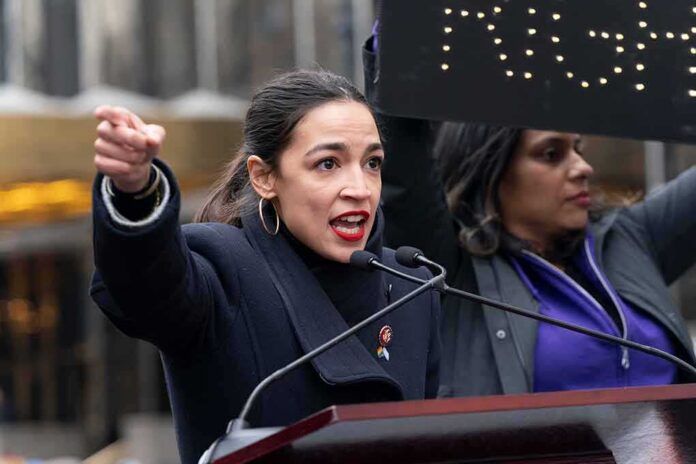
Democrats may be quietly laying the groundwork for a 2028 ticket built around the very “woke” brand that cost them ground with moderates—starting with Alexandria Ocasio-Cortez.
Story Snapshot
- Reporting in late 2025 said AOC’s team was weighing two 2028 paths: a presidential run or a New York Senate challenge to Chuck Schumer.
- AOC’s national travel and upstate New York events have fueled speculation about a broader statewide or national pitch.
- Digital fundraising and social reach are central to her strategy, reflecting how modern Democratic power is shifting from party institutions to online small-dollar networks.
- Democrats remain split after 2024 losses, with tension between progressive activists and more cautious, establishment-aligned figures.
AOC’s 2028 planning signals a progressive push, not a settled campaign
Axios reporting in September 2025 described AOC’s advisers actively preparing two potential routes for 2028: entering a Democratic presidential primary or challenging Senate Minority Leader Chuck Schumer in New York. No public decision was announced, and AOC’s office declined to comment on the deliberations. That matters, because the story is less about a declared candidacy and more about what it reveals—an organized effort to keep progressive options open while the party debates its future.
Recent public activity has kept the speculation alive. AOC appeared at upstate town halls—including stops such as Plattsburgh—and used language aimed at broader geographic inclusion, arguing that “no corner” of the state should be ignored. She also toured with Sen. Bernie Sanders on a “Fighting Oligarchy” swing that drew enthusiastic crowds and reinforced her status as a leading voice of the party’s activist left. The available reporting, however, stops in late 2025.
Schumer vs. AOC would expose the Democrats’ generational and ideological fault lines
Any move toward a Schumer challenge would put the Democratic Party’s internal contradictions in the spotlight. Schumer—an establishment figure with leadership power—would represent continuity and institutional control. AOC would represent an insurgent-style, media-savvy campaign aligned with the party’s progressive base. The reporting notes that Schumer’s 2028 reelection horizon, and his age, creates an opening for “old guard vs. new blood” framing that Democratic strategists and media analysts already recognize.
New York’s wider Democratic ecosystem adds friction. Separate 2025 political cross-currents cited in coverage—such as disputes over endorsements and intraparty tensions—show a party still negotiating who gets to set priorities after a national setback in 2024. For conservative readers tracking governance and cultural politics, that fight is not abstract: when progressives win internal power struggles, the policy agenda typically moves toward bigger government, heavier regulation, and ideological social policy—issues that have fueled public backlash in recent election cycles.
Digital fundraising is a major force multiplier—and a warning sign for party gatekeepers
A key factual thread in the reporting is how AOC’s operation uses digital tools to build leverage. Analysts cited her heavy digital ad spending and rapid growth in followers and donors, describing it as outpacing many peers. That model matters because it reduces reliance on traditional party structures and legacy donors, allowing high-energy ideological factions to sustain campaigns through small-dollar giving and constant online engagement. It is also a sign the next Democratic primary could be shaped by internet momentum as much as by governors and party bosses.
For Republicans, the “lottery ticket” framing promoted in conservative commentary remains an opinion, not a verified forecast. Still, the underlying strategic logic is straightforward: a nationally defined progressive brand can energize the GOP base and test Democratic strength with moderates, independents, and suburban voters—especially if kitchen-table concerns like prices, border enforcement, and public safety dominate the 2028 environment. The research provided does not include new polling proving the outcome, only the argument and the groundwork.
What’s known—and what isn’t—heading into 2026
The strongest verified facts are limited to what was reported by late 2025: AOC’s advisers were exploring a presidential run and a Senate run, she was building visibility through travel and events, and she was investing heavily in digital growth. The biggest unknown is whether she will actually choose either route, and when. With no official announcement in the provided material, the story should be read as a snapshot of ambition and preparation, not a formal campaign launch.
The Morning Briefing: GOP Will Hit the Lottery if AOC Is Dems' 2028 Nomineehttps://t.co/XaVuGN9iye
— PJ Media Updates (@PJMediaUpdates) February 17, 2026
Republicans heading into the Trump era’s second act will watch this closely for one reason: Democratic infighting often shapes national outcomes. If Democrats elevate candidates closely associated with unpopular “woke” cultural priorities or sweeping government programs, they risk repeating the coalition problems that followed the post-2020 years. If they retreat toward moderation, progressives could accuse leadership of selling out. Either way, AOC’s planning highlights a party still wrestling with what it stands for.
Sources:
https://www.axios.com/2025/09/19/aoc-2028-democrats-president-senate
https://www.aol.com/articles/aoc-other-2028-democratic-hopefuls-183048178.html