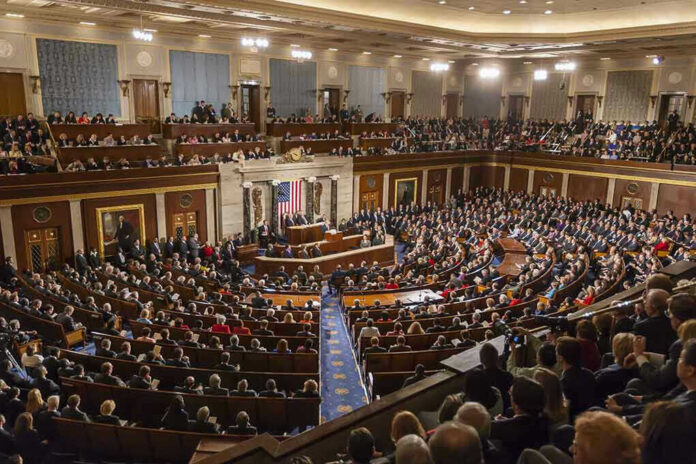
Congress faces an unprecedented bipartisan push to forcibly remove four scandal-plagued members in what could reshape how the House polices its own.
Story Snapshot
- Reps. Eric Swalwell (D-CA) and Tony Gonzales (R-TX) face immediate expulsion votes when the House reconvenes, with paired resolutions designed to overcome partisan resistance
- Sexual assault allegations, money laundering convictions, and ethics violations are driving rare cross-party agreement that “both need to go”
- Two additional members—Reps. Cory Mills (R-FL) and Sheila Cherfilus-McCormick (D-FL)—wait in the wings as potential next targets
- The effort faces a steep two-thirds vote threshold that has succeeded only 22 times in House history, most recently with George Santos in 2023
- House leadership remains conspicuously silent as rank-and-file members from both parties signal support for what they call “cleaning house”
When Ethics Scandals Collide With Political Reality
The House returns from recess on April 14, 2026, with expulsion resolutions sitting atop its agenda. Rep. Anna Paulina Luna plans to consult the House parliamentarian that day about pairing her motion to expel Swalwell with a Democratic resolution targeting Gonzales. This tactical pairing represents the key innovation: by linking opposite-party targets, lawmakers hope to neutralize the partisan self-protection that typically shields members from consequences. The strategy acknowledges a brutal truth about congressional accountability. Without reciprocal action, neither party will sacrifice its own.
The Swalwell Controversy Unravels a Political Career
A former Swalwell staffer’s allegations of sexual assault, published in the San Francisco Chronicle, triggered a Manhattan District Attorney criminal probe and forced the California Democrat to abandon his 2026 gubernatorial bid. Swalwell admitted exercising “lack of judgment” while maintaining the encounters were consensual and denying all accusations. He sent a cease-and-desist letter to his accuser but faces mounting pressure from colleagues. The timing proved devastating: allegations surfaced just as his statewide campaign gained traction, transforming what could have been a defensive political liability into a career-ending scandal that even fellow Democrats now use to justify expulsion.
Gonzales Faces His Own Reckoning
Rep. Tony Gonzales admitted to a relationship with a staffer amid a House Ethics Committee investigation into sexual misconduct allegations. The Texas Republican already announced he would not seek reelection, suggesting he recognized the political impossibility of surviving both the scandal and a primary challenge. His situation differs from Swalwell’s in crucial ways: Gonzales acknowledged the relationship rather than outright denying wrongdoing, and he faces allegations of misconduct within a power-imbalanced workplace dynamic rather than criminal assault claims. These distinctions may matter legally but appear irrelevant politically, as bipartisan voices now lump both cases together as equally disqualifying.
The Money Launderers and Alleged Abusers Waiting Their Turn
Rep. Sheila Cherfilus-McCormick received a guilty finding from the Ethics Committee for over two dozen violations, including money laundering and false statements related to funneling more than five million dollars in disaster relief funds to her campaign and personal use. She faces potential decades in prison yet continues running for reelection while denying wrongdoing. Rep. Cory Mills confronts allegations of domestic violence, stolen valor, and financial misconduct involving contractor ties, all under Ethics Committee investigation. Both Florida representatives lack the same-party support that might shield them, making them vulnerable second-wave targets if the Swalwell-Gonzales expulsions succeed.
Bipartisan Voices Demand Accountability
The supporting cast reads like a who’s who of political opposites finding common cause. Rep. Byron Donalds called the allegations against both men “despicable” and declared “both need to go home” during an NBC interview. Progressive Rep. Pramila Jayapal co-signed support alongside conservative firebrands like Nancy Mace, who tersely demanded “expel all of them.” Rep. Teresa Leger Fernandez introduced the counter-resolution against Gonzales, creating the reciprocal mechanism that makes the entire strategy viable. This coalition defies the usual partisan tribalism because each side holds leverage over the other. Nobody wants to be the party protecting predators while attacking the other side’s misconduct.
The Historical Weight of Expulsion
Expelling a House member requires a two-thirds supermajority, a threshold so steep that Congress has used it successfully only 22 times throughout American history. Most expulsions occurred during the Civil War era when Confederate sympathizers abandoned their posts. The modern Congress typically settles for censures, reprimands, or waiting for criminal convictions to force resignations. George Santos became the most recent expulsion in 2023 after his fabricated resume and campaign finance fraud became undeniable, though President Trump later pardoned him in 2025. The Santos precedent matters here: it demonstrated that House members will expel colleagues when the evidence becomes overwhelming and the political cost of inaction exceeds the cost of a special election.
Why Leadership Stays Silent While Members Speak Out
Speaker Mike Johnson and Democratic leadership have issued no public comments on the expulsion push, a silence that speaks volumes about the political minefield they face. Leadership typically protects members to avoid triggering special elections that could flip seats or force costly defensive campaigns. The narrow House margins make every seat precious, yet defending accused sexual predators and convicted money launderers carries its own electoral poison. By staying quiet, leaders avoid either endorsing removal of their own members or appearing to shield wrongdoers. They leave the rank-and-file to drive the process, preserving plausible deniability regardless of outcome while the Ethics Committee operates as the supposedly independent enforcer.
The Two-Thirds Problem That Makes Success Uncertain
Jon Taylor, political science chair at the University of Texas at San Antonio, called potential expulsions “stunning” given the short time remaining in these members’ terms, which end in January 2027. He suggested letting them finish to avoid special elections for what he colorfully termed “congress member for Christmas” seats, expressing skepticism about passage. The math supports his doubt: achieving 290 votes in a divided House requires dozens of members to cross party lines and remove colleagues. The paired resolution strategy attempts to solve this by making cross-party votes symmetrical, but it also means both expulsions must succeed or the entire effort collapses into partisan recrimination.
What Happens If the House Actually Votes
Special elections in California’s 14th District, Texas’s 23rd District, and potentially two Florida districts would dominate the lame-duck session if expulsions succeed. These contests would occur with terms ending in mere months, creating expensive campaigns for short-lived seats that nonetheless could swing critical votes on year-end legislation. Districts would lose representation during the transition, disadvantaging constituents who need constituent services or advocacy. The precedent would embolden future expulsion efforts, potentially triggering a wave of ethics-based removals or strategic resignations to avoid the spectacle. Failure, conversely, would signal that even bipartisan disgust cannot overcome the institutional inertia protecting members from consequences.
The Broader Message About Congressional Accountability
This moment tests whether Congress can enforce standards on itself when voters demand action but partisan self-interest counsels protection. The allegations involve fundamental betrayals: abuse of power over subordinates, theft of disaster relief funds meant for hurricane victims, lies about military service. These are not minor ethics lapses or political disagreements but alleged crimes and moral failures that transcend ideology. The bipartisan coalition argues that tolerating such behavior destroys institutional credibility more than losing a few seats ever could. Whether their colleagues agree will determine if “cleaning house” remains a slogan or becomes a governing principle that reshapes congressional culture.
Sources:
Momentum Grows for Expulsion of Multiple Scandal-Ridden House Lawmakers – NOTUS
Lawmakers put expulsion threats atop House agenda as return sets up high-stakes week – WFMD
US Congress members facing expulsion amid sexual misconduct accusations – News4SanAntonio