When teenage gunmen can walk into a house of worship, leave anti-Islam scrawls on their weapons, and force families to ask whether anyone in power will actually fix what fueled the hate, something is badly broken far beyond San Diego.
Story Snapshot
- Police say two teenagers killed three men at San Diego’s largest mosque before dying of apparent suicides, leaving five dead in total.
- Officials are treating the rampage as a possible hate crime after anti-Islamic writings were found on a gun and in a vehicle.
- Children at the mosque’s school were safely evacuated, but worshippers describe lasting fear and trauma.
- The case highlights growing anger that leaders condemn hate yet struggle to confront deeper roots of radicalization and violence.
What Officials Say Happened At The Islamic Center
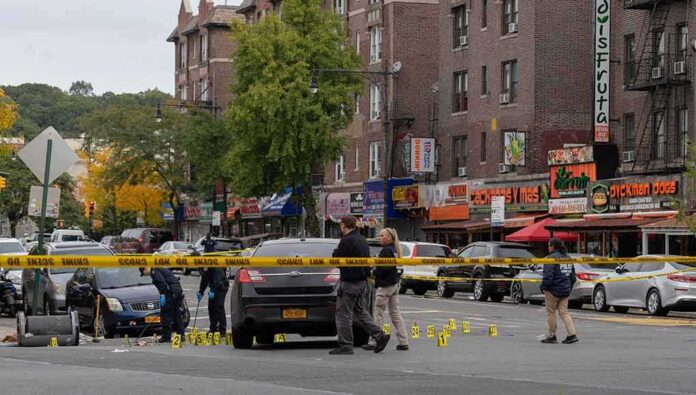
San Diego police say the violence began late Monday morning, when two armed teenagers entered the Islamic Center of San Diego, the county’s largest mosque and an Islamic school, and opened fire on adults gathered near the front of the complex.[1][2][5] Officers arrived within minutes after 911 calls reported an active shooter and discovered three men dead outside the center. Officials later confirmed the suspects fled the scene by car, firing more shots in nearby streets before the rampage ended.[1][2]
Police state that a landscaper working roughly half a mile from the mosque reported being shot at but was not injured, underscoring how quickly the chaos spilled into surrounding neighborhoods.[1] A short time later, officers located a vehicle several blocks away and found both teenage suspects dead inside from apparent self-inflicted gunshot wounds, bringing the total number of dead to five.[1][2] Authorities say they believe there is no ongoing threat to the community from additional attackers.[1]
Why Investigators Are Probing A Possible Hate Crime
San Diego Police Chief Scott Wahl told reporters the department is treating the case as a hate crime “until it is not,” citing the mosque setting and early physical evidence pointing toward anti-Islamic motives.[1][5] Law enforcement sources say one of the long guns recovered from the suspects carried hate speech written on it, and additional anti-Islamic writings were found inside a vehicle linked to them.[1] Investigators say at least one suspect took a firearm from a parent’s home and left a suicide note referencing “racial pride.”[1]
Officials emphasize that the motive finding remains preliminary, and they still must reconstruct the suspects’ planning, online activity, and communications before prosecutors can formally classify the case under hate-crime statutes.[1] That cautious approach reflects a broader pattern after mass attacks, where authorities signal a likely motive early on but stress that final conclusions depend on evidence that can stand up in court. For many Americans watching from the outside, that hedging can look like either responsible restraint or the system protecting itself.[1]
Children Spared, Community Shaken
The shooting erupted while classes were in session at the mosque’s school, raising immediate fears that children had been caught in the gunfire.[1][2][3][5] Police and mosque leaders later said all students were safely evacuated and that no children were physically injured, a fact the imam highlighted in a video message to reassure terrified parents.[1][2][3] Video from the scene shows children running from the complex as heavily armed officers secure the area, a haunting image that will stay with families long after the crime tape is gone.[3]
https://twitter.com/Hak_2861/status/2056734669412909468
Faith leaders describe the attack as the latest symptom of what the Islamic Center’s imam has called “unprecedented” levels of hate and intolerance directed at Muslims in recent years. Elected officials from across Southern California quickly issued statements of condemnation and solidarity, insisting that “hate has no home” in the region and promising support for victims and their families.[3] For many congregants, though, the question is less whether politicians will speak out and more whether anything will change in how authorities confront threats before they turn deadly.
Deeper Questions About Hate, Security, And Government Failure
Residents across the political spectrum are asking hard questions that go beyond this single tragedy. Some want to know how teenagers could apparently arm themselves with long guns, inscribe hate messages on weapons, leave a suicide note about “racial pride,” and still go unnoticed until bodies were on the ground.[1][2] Others see another example of a pattern: public officials deliver strong words after a mass shooting, federal and local agencies promise coordination, and then the country moves on while the root causes—online radicalization, alienated youth, untreated mental distress, political demonization—remain largely unaddressed.
The Federal Bureau of Investigation (FBI), the Bureau of Alcohol, Tobacco, Firearms and Explosives, and local law enforcement are all assisting in this investigation, but their presence also reminds many Americans of a deeper frustration.[1][4][5] Conservatives and liberals alike worry that massive security bureaucracies are quick to monitor ordinary citizens yet still miss obvious warning signs, whether in school threats, extremist chat rooms, or violent social media posts. For people who already believe a distant “deep state” protects its own while leaving neighborhoods exposed, the San Diego mosque shooting will harden doubts about whether government servants are capable—or willing—to protect both religious freedom and basic public safety in a time of rising anger and distrust.
Sources:
[1] Web – San Diego shooting: 5 dead in mosque attack; anti-Islam … – LA Times
[2] Web – Suspects killed in Islamic Center of San Diego shooting | KTVU FOX 2
[3] Web – Mayor Bass Releases Statement on Deadly Attack at Islamic Center …
[4] YouTube – Mayor, Imam speak at press conference with Police, FBI
[5] YouTube – San Diego officials detail shooting at Islamic Center