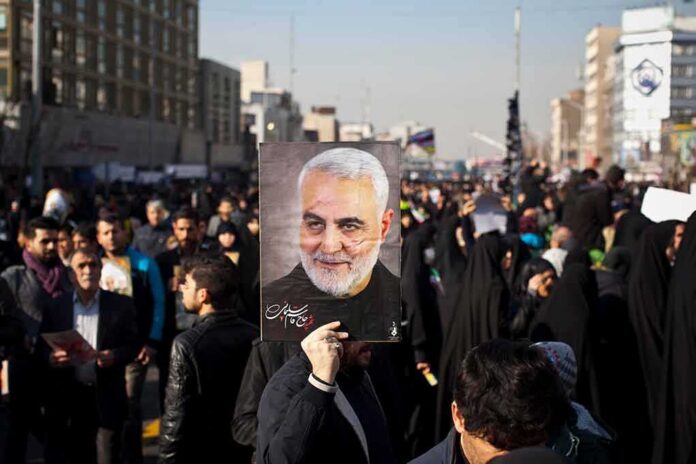
Iran’s six-day funeral for Ayatollah Ali Khamenei is drawing gigantic crowds and intense state control, turning grief into a raw show of regime power in the middle of a shooting war.
Story Snapshot
- A six-day funeral is moving through Iran and Iraq, with officials claiming crowds in the tens of millions.
- The route passes key Shiite holy cities, blending religion, nationalism, and wartime messaging.
- Independent reporters see “tens of thousands,” not “millions,” raising big questions about crowd claims.
- The new Supreme Leader, Mojtaba Khamenei, is absent and reportedly wounded, feeding uncertainty about Iran’s future.
A funeral turned into a rolling show of strength
Iran began a six-day funeral procession for former Supreme Leader Ayatollah Ali Khamenei on July 4, 2026, almost four months after he was killed in joint United States–Israeli airstrikes. The ceremonies start in Tehran and then move through Qom, across the border to Najaf and Karbala in Iraq, and finally to Mashhad, his birthplace and home to a major Shiite shrine. That route is not random. It ties Khamenei’s image to some of the holiest sites in Shiite Islam and to Iran’s claim to lead the wider Shiite world.
Tehran’s mayor, Alireza Zakani, says the funeral in the capital could pull almost 20 million people, which would be the largest gathering in the city’s history. Iranian officials also say between 8 million and 10 million people may attend the burial in Mashhad. State media repeat these huge numbers and show wide shots of packed squares and long lines of mourners. The government has declared at least one public holiday and is offering transport, food, and lodging to help fill the streets.
Massive crowds, but a big fight over the numbers
Big crowds are clearly real. Videos from Tehran’s Grand Mosalla prayer complex show thousands, and in some clips what look like hundreds of thousands, of people lining up to view Khamenei’s casket, which is draped in Iran’s flag. Foreign outlets such as NBC News and the New York Times also describe “huge crowds” as the official mourning period begins. Yet some reporters on the ground say the turnout is smaller than officials claim. One BBC correspondent describes the Tehran crowds as “tens of thousands,” which clashes sharply with talk of 20 million.
This kind of gap is not new. During the 2020 funeral of General Qasem Soleimani, Iranian officials spoke of 15–20 million mourners, while outside estimates based on satellite images and crowd studies landed closer to hundreds of thousands or about a million. Political scientists who track authoritarian systems find that rulers often inflate crowd numbers by several times to project power and unity, especially during war. The same pattern appears here, with Iran’s leaders using the funeral to claim that the country is totally united behind the system, even though many citizens resent the clerical rule and the economic pain it has brought.
Security, silence, and the missing new Supreme Leader
The funeral also shows how tightly controlled public life can be under an aggressive state. Reports describe central Tehran under heavy security, with streets locked down, transport redirected, and cameras focused on approved routes and squares. Sunday was made a public holiday to ease mass attendance, and more than 4,000 people went to nearby medical centers, though there were no reported deaths that day. At the same time, Iran has banned the use of BBC reporting in Persian-language media inside the country, limiting how much independent coverage ordinary Iranians can see.
One of the most striking details is who is not there. Mojtaba Khamenei, the late leader’s son and the new Supreme Leader, has not appeared at the ceremonies and is believed to have been wounded in the same airstrikes that killed his father. That absence matters. In past major funerals, including those for President Ebrahim Raisi, Ayatollah Ali Khamenei himself led prayers to show that the top of the system was steady and in charge. Now the state is trying to project strength while its new top figure is offstage, and that raises questions about real stability behind the scenes.
Why this matters beyond Iran’s borders
For Americans watching from far away, this huge, state-managed funeral is a reminder of how governments can use tragedy to tighten control. Iran’s rulers are trying to turn Khamenei’s death into proof that their system still commands deep loyalty, even after years of protests, sanctions, and economic crisis. They are doing it in the middle of a war with the United States and Israel, and they are tying religious faith, national pride, and anti-American slogans all into one emotional event.
Iranian President Masoud Pezeshkian will travel to Iraq to attend funeral ceremonies for former Supreme Leader Ali Khamenei in Najaf and Karbala, the semi-official ISNA news agency reported on Monday.
It also denied earlier reports that Mostafa Khamenei, Khamenei’s eldest son,…
— Alex kennedy (@Alexkennedy213) July 6, 2026
Many in the United States, both conservatives and liberals, feel like elites use big public moments to sell a story and avoid hard truths. In Iran, the story is about unity and strength against foreign enemies. In America, the messages are different, but the worry is similar: are leaders more focused on image than on fixing real problems? Watching Iran’s rulers claim “millions” of mourners while controlling the media and pushing aside dissent offers a sharp example of how any government, including our own, can put theater ahead of honesty when the stakes are high.
Sources:
youtube.com, cnbc.com, time.com, bbc.com, instagram.com, nbcnews.com, facebook.com
© headlineupdates.com 2026. All rights reserved.