President Trump just used executive power to get TSA agents paid during a DHS funding lapse—raising a bigger question about how long Washington can keep governing by crisis while ordinary Americans sit in airport lines.
Story Snapshot
- President Trump signed a March 27 executive order to repurpose federal funds so TSA employees can receive pay during the DHS funding impasse.
- DHS Secretary Mark Wayne Mullen said paychecks could arrive as soon as Monday (March 30), after weeks of mounting stress on TSA families and staffing levels.
- Airports reported strained operations tied to absenteeism and long security lines, with travelers still told to arrive 2–3 hours early as conditions stabilize.
- The Senate approved a DHS funding bill late March 27, but House Republicans rejected it, leaving broader DHS functions unresolved even as TSA pay relief moves forward.
Trump’s Executive Order: Immediate TSA Relief Without a Full DHS Deal
President Donald Trump signed an executive order on Friday, March 27, directing the administration to repurpose certain funds to cover Transportation Security Administration pay during the Department of Homeland Security funding lapse. Administration messaging emphasized that the move relied on a “reasonable and logical nexus” between the redirected funds and TSA operations. The aim was simple: get frontline screeners paid fast enough to stabilize staffing and keep airports moving.
DHS Secretary Mark Wayne Mullen said the plan could put money in TSA workers’ hands as soon as Monday, March 30, with some uncertainty about whether payments would land Monday or Tuesday. That timeline mattered because the operational problem was already visible to travelers: long lines, stressed staff, and airports telling the public to build in extra time. The reporting also framed the move as a partial fix while the larger shutdown remained unsettled.
What the Disruption Looked Like on the Ground for Travelers and Workers
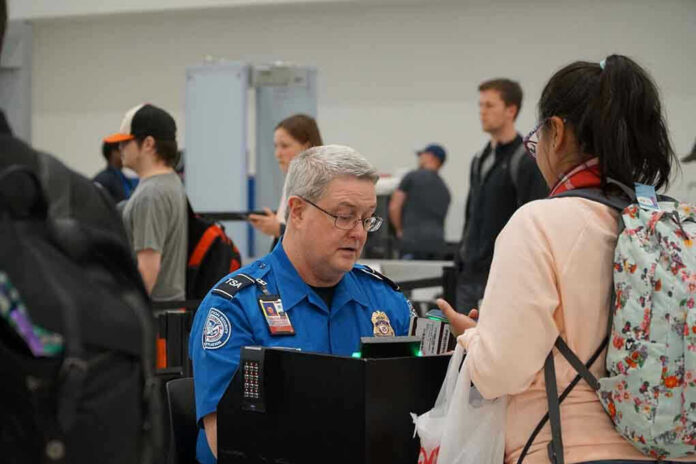
Airports experienced the kind of dysfunction Americans have come to expect when Congress fails to do basic budgeting. Reports described significant TSA absenteeism—numbers cited included up to 40% call-outs and about 500 agents absent—driving longer waits at checkpoints. Travelers were still advised to arrive two to three hours early even as conditions began to ease. For many families, the practical issue was immediate: missed pay means rent, food, and bills do not pause.
The story’s timeline suggested that the executive action quickly improved the outlook for airport operations, at least compared with the worst days of the staffing crunch. Still, officials and reporters acknowledged a key limitation: paying TSA addresses one critical pressure point, but it does not automatically reopen or fully fund all DHS responsibilities. That distinction matters for public safety and disaster readiness, because DHS also includes major components beyond airport screening.
The Capitol Hill Stalemate: Senate Passage, House Rejection, and No Clean Resolution
The legislative backdrop remained muddy even as the administration moved ahead. The Senate approved a DHS funding bill late Friday, March 27, covering agencies that include TSA, FEMA, and the Coast Guard. House Republicans then rejected that bill as a “joke,” leaving the standoff unresolved. The reporting’s framing focused heavily on Democrats as obstructing, but the known facts in the available material also show Republicans refusing the Senate package.
Conservative Concerns: Executive Workarounds vs. Congress Doing Its Job
Many conservative voters like seeing competence restored at the border, in law enforcement, and in public order—but they also expect constitutional guardrails and a Congress that appropriates funds instead of punting every crisis to the Oval Office. Repurposing money through an executive order may be legal under whatever authorities the administration relied on, yet it underscores a recurring pattern: Washington stops functioning, then asks the executive branch to improvise.
Limited source material makes it hard to independently confirm every operational statistic cited in the reporting, including precise absenteeism rates and the full internal accounting behind the funding “nexus.” What is clear is the immediate political reality: airport travelers and TSA families wanted pay restored, and the administration acted. The unresolved question is whether Congress will pass a durable DHS funding solution—so Americans are not stuck repeating the same shutdown-cycle chaos at the next deadline.
Dems Outfoxed Again: Airports Returning to Normal As Trump Finds Way to Pay TSA Agentshttps://t.co/WxjwXMSPqT
— RedState (@RedState) March 30, 2026
For voters who are tired of fiscal mismanagement, high costs, and government dysfunction, the episode cuts two ways. The administration’s quick fix helped stabilize a public-facing system that millions depend on. At the same time, it highlighted how easily basic services become bargaining chips when lawmakers cannot or will not pass timely appropriations. The country can’t run indefinitely on emergency measures—no matter which party gets the blame in the moment.