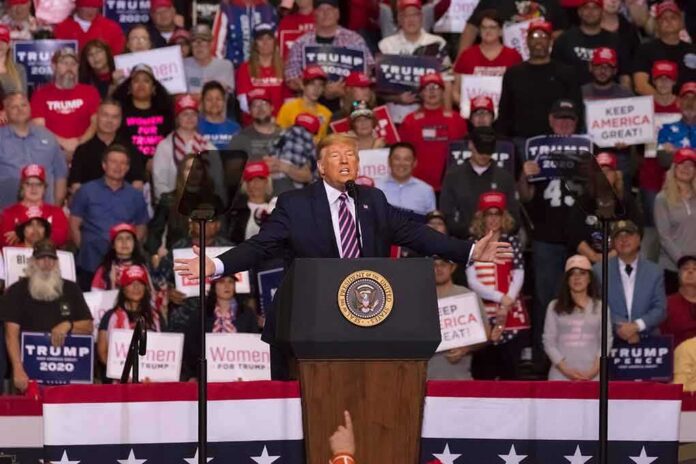
Presidential travel is a campaign instrument with limits: it can set an agenda, concentrate media, and rally volunteers at scale—yet it cannot repeal the structural midterm penalty. President Trump’s final 2026 push exemplified both the reach and the constraints of modern presidential campaigning.
At a Glance
- President Trump executed a 32-day midterm “travel blitz” spanning 30 events across 20 states, with sustained day-after-day activity in October.
- The operation mixed in-person rallies and late-stage tele-rallies to maximize reach in a compressed final week.
- Two headline cancellations—in Kansas and Iowa—were reversed within about a day, underscoring a rapid-adjustment posture.
- The effort focused repeatedly on electorally salient states, reflecting the campaign’s map-driven targeting.
What Happened: A High-Tempo Presidential Midterm Operation
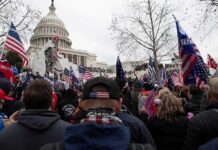
The White House framed the president’s late-2026 effort as a “historic travel blitz”: 30 campaign-related events over 32 days across 20 states, including a stretch of 21 events in 21 days and at least one event on 12 consecutive days. In practical terms, that cadence requires a disciplined advance operation—site selection, crowd logistics, surrogate integration, and local media coordination—layered onto Air Force One movements and protective details. The itinerary emphasized a familiar blend: marquee rallies to energize base voters; regional stops to feed local TV markets; and phone-based or virtual “tele-rallies” to extend the candidate’s presence where time and distance would otherwise force trade-offs.
Even in a well-oiled tour, late-stage friction is inevitable. The most visible hiccup came when rallies slated for Kansas and Iowa were canceled, with the Republican National Committee citing a pivot to tele-rallies that could reach more voters as the clock ran down. Within roughly 24 hours, those in-person events were reinstated and set for November 1, a weekend crescendo that restored the original symbolic targets while preserving the broadened outreach strategy. That reversal wasn’t a contradiction so much as an admission of the real constraint all late-cycle operations face: there are never enough hours, so campaigns stack modalities to buy more reach per unit of time.
Mechanics: Why Mix Rallies and Tele-Rallies?
A presidential rally is both message and mechanism. The message is the candidate’s closing frame; the mechanism is measurable mobilization—volunteer sign-ups, county-party routing of attendees into canvass and phone banks, earned media, and social amplification. Tele-rallies trade the spectacle for speed. With a dial-in or digital broadcast, campaigns can target dozens of districts in a night, splice in local candidates, and repurpose content for rapid distribution. In the final 96 hours, when late deciders are thin and turnout is king, maximizing contacts often outruns maximizing crowds.
The Trump team’s adoption of both tools fit that logic. The RNC described the tele-rally shift as a way to “reach more voters in the limited time left before polls close”; when the Kansas and Iowa events returned to the schedule, the campaign effectively chose “both/and” over “either/or.” From an operations standpoint, that flexibility matters more than any one venue’s optics. It also explains repeated returns to priority states—three trips to Ohio, four to Texas—where sustained presence can refresh local news cycles and reinforce field programs in the same media markets.
Targeting and the Map: Where the President Went—and Why
Presidential travel isn’t a scavenger hunt; it’s a map test. The White House listed multiple passes through Georgia, Iowa, Kansas, Ohio, South Carolina, and Texas—jurisdictions with competitive or strategically important races. Repetition signals priority. It tells donors where to focus, channels national volunteers into specific field offices, and cues allied media to keep cameras trained on the same battlegrounds. This is one way a president’s political capital converts to party capacity: by aligning attention with the tightest margins and the most elastic voters.
That said, even a highly active schedule is still operating inside midterm arithmetic. Since 1946, in 18 of 20 midterms the president’s party has lost House seats—about a 90 percent “midterm penalty”—with long-run averages near 26–27 House seats and around four Senate seats lost, depending on the time window studied. Those base rates don’t predetermine outcomes in a given cycle, but they do define the headwind against which any travel blitz must row.
The Kansas and Iowa Reversal: Scheduling Friction, Strategic Signal
Why did the cancellations matter? Not because the campaign abandoned those states—it didn’t—but because schedule volatility becomes a story in its own right in the final week. National outlets and local press flagged the pullback, then documented the whiplash when the rallies returned to the calendar, shifting coverage toward the process and away from message. That narrative tax is the hidden cost of last-mile optimization. The underlying rationale—expand tele-reach, then restore in-person shows of force—was coherent; the media cycle nonetheless highlighted uncertainty. Campaigns accept that trade when they believe marginal contact gains outweigh a day of unfavorable coverage.
The episode also illuminated why late-game presidential travel decisions are unusually complex. Each stop forces hard choices among candidate time, surrogate deployment, and airframe availability; each change triggers venue contracts, security replans, and local partner recalibration. Rapid reversals are best understood as operational responses inside a rigid calendar, not as strategic about-faces.
What This Can and Cannot Prove About Electoral Effects
The record is clear on activity: event counts, dates, and locations are documented, as is the mixed use of in-person and tele-rally formats. What it cannot establish on its own is magnitude of electoral effect. Turnout surges, vote-share shifts, fundraising bumps—those require event-level data, matched comparisons, and postelection analysis that isolates the rallies’ contribution from broader forces. That is not a defect of this operation; it is the general problem in causal campaign inference. The responsible conclusion is straightforward: the Trump operation achieved high-volume, multi-modal exposure across the party’s priority map; whether that exposure translated into seat control depends on district-level dynamics and the larger midterm climate.
Historical context reinforces the caution. The midterm penalty is persistent but not absolute—1998 and 2002 were exceptions with unique conditions—so presidential campaigning can matter at the margins, particularly in low-salience House races where a late injection of cash, coverage, and volunteers can flip close contests. Yet no travel schedule, however intense, reliably neutralizes a negative national environment. In that sense, the 2026 blitz fit the optimal playbook for an incumbent party under headwind: saturate target markets, keep message discipline, diversify modalities, and squeeze the calendar to harvest marginal gains where they exist.
The Strategic Takeaway: Capacity, Flexibility, and the Limits of Incumbency
Three conclusions endure beyond the cycle. First, capacity matters. Sustaining 30 appearances across 20 states in barely a month reflects organizational depth—from advance teams to communications to political desk—that few national operations can match. Second, flexibility is not a luxury; it is the late-stage strategy. The Kansas/Iowa episode showed a willingness to reallocate the president’s time across formats and then quickly restore high-visibility venues when feasible. Third, incumbency cuts both ways. A president can project attention at national scale, but also inherits the midterm baseline that history suggests is stubborn.
Sources:
youtube.com, whitehouse.gov, cnbc.com, cnn.com, npr.org, presidency.ucsb.edu
© headlineupdates.com 2026. All rights reserved.