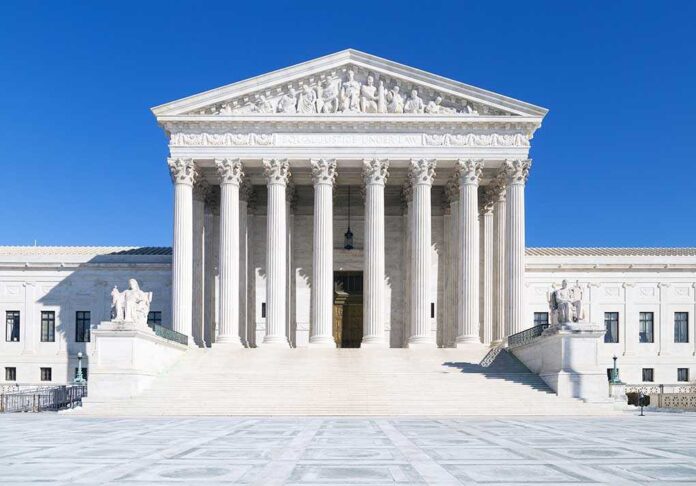
The Supreme Court justices signaled they may soon cement biological sex as the defining line in women’s sports, potentially sidelining transgender athletes nationwide and igniting a fairness revolution.
Story Snapshot
- Supreme Court heard oral arguments January 13, 2026, in Idaho and West Virginia cases challenging transgender bans in girls’ sports.
- Majority of justices leaned toward upholding bans to protect biological females’ competitive fairness.
- Idaho’s Lindsay Hecox and West Virginia’s Becky Pepper-Jackson sued, claiming discrimination under Title IX and the 14th Amendment.
- Decision expected spring 2026 could redefine “sex” in sports nationwide.
- Conservative justices emphasized state deference amid scientific uncertainty on hormone effects.
Idaho and West Virginia Enact Pioneering Bans
Idaho passed the Fairness in Women’s Sports Act in 2021. This law bars transgender girls from girls’ teams based on biological sex at birth. West Virginia enacted the SAVE Women’s Sports Act the same year. Both states aimed to preserve opportunities for cisgender female athletes. Lindsay Hecox, a transgender woman, challenged Idaho’s ban to join the women’s track team. Becky Pepper-Jackson, a 15-year-old transgender girl, sued West Virginia after exclusion from middle school track.
Lower courts blocked enforcement. The 9th Circuit halted Idaho’s law under 14th Amendment equal protection. The 4th Circuit stopped West Virginia’s under Title IX. These rulings forced states to defend their laws at the Supreme Court. The bans reflect 27 states’ actions by 2026, prioritizing biological distinctions in sex-segregated sports.
Common sense aligns with states’ position. Biological males retain advantages like muscle mass and bone density even after hormone therapy. Facts support protecting Title IX gains for girls, earned through decades of advocacy.
Supreme Court Oral Arguments Unfold
The Court heard nearly 3.5 hours of arguments on January 13, 2026. Justices focused on fairness in women’s sports. Conservative majority, including Kavanaugh, questioned blanket inclusion of transgender athletes. Kavanaugh urged avoiding constitutional overreach amid scientific uncertainty. Gorsuch probed nuances from the 2020 Bostock ruling on sex discrimination.
Liberal justices like Sotomayor and Jackson challenged bans’ breadth. They asked if hormone therapy negates advantages in individual cases. States’ attorneys, including Idaho’s Alan Hurst, defended categorical rules. Trump administration lawyer Hashim Mooppan backed states, citing Title IX regulations.
Stakeholders Clash on Rights Versus Fairness
ACLU and Lambda Legal represent plaintiffs. They argue bans discriminate and harm transgender youth development. Sasha Buchert of Lambda claimed exclusions damage self-esteem. Joshua Block of ACLU said denial of sports violates education rights. Plaintiffs seek equal opportunities under law.
States counter that fairness demands sex-based teams. Cisgender girls lose spots and scholarships to biologically stronger competitors. Rallies outside the Court featured advocates, families, and lawmakers. Power dynamics favor conservative justices’ deference to legislatures.
American conservative values affirm biological reality over feelings. Blanket bans make sense where data shows persistent advantages. Individual exceptions risk verification nightmares and erode trust in women’s divisions.
Potential Ruling Reshapes Sports Landscape
A ruling upholding bans would validate 27 states’ laws. It could extend to the other half, influencing NCAA and high school policies. Transgender youth face exclusion, impacting mental health and teamwork skills. Schools grapple with compliance and verification.
Politically, victory deepens divides. Republicans unite behind fairness; Democrats fracture on inclusion. Long-term, the decision clarifies “sex” in Title IX and 14th Amendment contexts. Litigation costs burden states, but precedent secures women’s sports integrity.
Sources:
https://www.scotusblog.com/2026/01/supreme-court-appears-likely-to-uphold-transgender-athlete-bans/
https://www.politico.com/news/2026/01/13/supreme-court-state-transgender-athlete-bans-00722345