
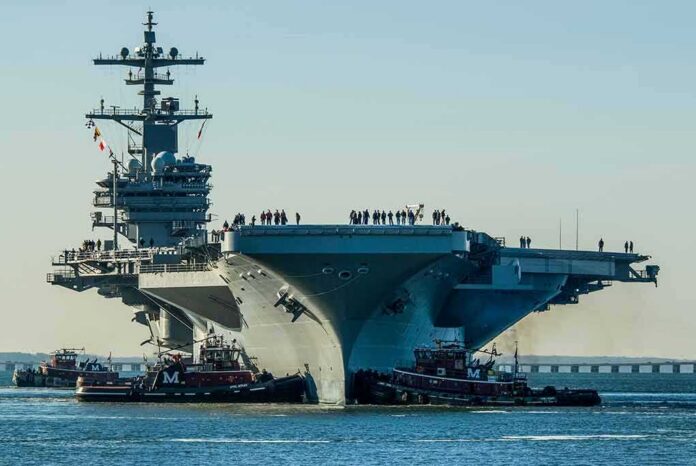
Hundreds of Navy families were told to brace for a possible 12-month deployment because the carrier’s Iran mission is not done.
Story Snapshot
- Navy leaders told families on November 9 the carrier would miss the holidays and could stay out up to a year.
- The George H.W. Bush strike group left Norfolk on March 31 for six to seven months but was extended again.
- Commanders tied the longer mission to Iran-related maritime security and blockade duties.
- Multiple outlets reported the town hall and the new guidance to prepare for a worst case of 12 months.
What Navy Leaders Told Families And Why It Matters
Navy leaders faced about 500 family members at Naval Station Norfolk on November 9. They said the George H.W. Bush would not return for the holidays. They also told families to prepare for a worst-case yearlong deployment. Capt. Justin Issler then informed sailors that the deployment had been extended, according to reporting that covered the meeting and follow-on message. The Navy linked the extension to a continued mission tied to Iran and the need to keep pressure on threats to shipping and regional stability.
The Bush strike group left Norfolk on March 31, 2026, for a standard six-to-seven-month cruise. Reporting states this was the second extension since departure. Families were told on November 9 that the mission could now stretch to 12 months in the worst case. The guidance was direct: plan for longer separation and expect more time at sea. The message landed hard because it means missed holidays and shifting child care, jobs, and finances with little notice.
The Operational Rationale And The Iran Link
The Navy tied the extension to Iran-focused tasks that include protecting sea lanes and backing a blockade effort. Commanders need a carrier to hold airpower close to the problem. That platform can launch jets, manage air defense, and deter attacks on ships. The carrier’s reach gives decision makers daily options without basing rights on land. Reports placed the Bush squarely in that role and said the mission would continue as threats persisted.
Calls to prepare for a year do not mean the ship must stay that long. Navy leaders framed it as a worst case. That matters for planning at home. It sets a high bar so families do not face another surprise if the timeline slips again. But it also built public pressure because people heard “12 months” and focused on the strain, not the caveat. Several outlets confirmed the holiday absence and the yearlong plan as the standard to prepare for.
Why Extensions Keep Happening Across The Fleet
This extension fits a wider pattern. Combatant commanders ask for more carrier time than the Navy can supply on a neat seven-month rhythm. In recent years, carriers such as the Gerald R. Ford and Dwight D. Eisenhower stayed out well beyond 250 days during crisis surges. Some cruises hit lengths last seen in the Vietnam era. Demand stacks up faster than maintenance and training cycles can reset, so extensions spread to keep presence where risks climb.
Defense reporting has traced this cycle stress for years. Analysts describe a squeeze from global demand, long shipyard periods, and limited spare capacity to swap carriers at speed. The result is longer stints at sea and tighter turnarounds at home. That pattern does not prove every single extension is the only option, but it explains why “plan for longer” has become familiar to families. The Bush’s extended timeline matches that environment and current regional need.
The Human Cost Families Are Managing Right Now
About 500 family members came to the Norfolk town hall to get answers. They asked about timing, mental health, and support they could count on. News coverage captured anger and fear about repeated changes and the toll on marriages, kids, and finances. One report described a spouse who said her sailor faced pushback when seeking care for mental health concerns tied to the strain of the deployment tempo. These stories highlight why clear notice and steady support are vital.
American conservative values prize duty and deterrence, but they also demand straight talk, a defined mission, and care for the people who carry it out. The Navy met families in person, which shows respect. The stated aim—secure seas and deter attacks—tracks with common sense and national interest. The gap is clarity on the off-ramp. Families can accept hard service if leaders state the goalposts, share the plan to rotate forces, and deliver the promised support at home.
What To Watch Next
Watch for an official schedule update that narrows the window from “plan for 12 months” to a firmer timeline. Look for signs that another carrier will take the watch so the Bush can turn for home. Monitor whether command channels keep up regular, plain updates as the mission evolves. Finally, track whether family services scale to the longer haul. Strong communication and visible support can steady morale while the mission runs its course.
Sources:
navytimes.com, militarytimes.com, jfeed.com, timesnownews.com, x.com
© headlineupdates.com 2026. All rights reserved.