Memphis didn’t get safer because criminals suddenly grew a conscience—it got safer because a rare, forceful government partnership decided fear wasn’t an acceptable way to live.
Quick Take
- The Memphis Safe Task Force combined local policing with a federal surge that included National Guard support and agencies like the FBI, ATF, DEA, U.S. Marshals, and ICE.
- Officials reported thousands of arrests and hundreds of guns seized, alongside steep drops in serious crime compared with prior-year periods.
- Memphis became a case study in what happens when a high-crime city accepts outside help rather than fighting it on principle.
- The praise comes with an open question: can a surge strategy deliver lasting order without drifting into mission creep, especially on immigration enforcement?
What the “Memphis Safe Task Force” Actually Changed on the Ground
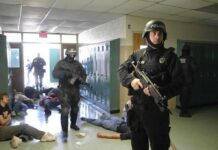
Memphis launched the Memphis Safe Task Force in late September 2025 after years of violent crime that locals described less as a crime wave and more as a daily tax on normal life. The mechanics mattered: federal agents brought manpower, intelligence capabilities, and warrant capacity; the National Guard added visible presence and logistical support. The result wasn’t just more patrol cars—it was a citywide signal that consequences were back in style.
Numbers drove the story because numbers are hard to argue with. Officials cited more than 1,700 arrests in a recent one-month stretch, cumulative arrests above 3,000 since the operation began, and firearms seizures that climbed into the hundreds. The task force also reported locating missing children and arresting identified gang members—details that cut through abstract debate. If your neighborhood has lived with random gunfire, that specificity lands.
Why This Federal Surge Worked Where Others Sparked Revolts
Federal intervention in American cities usually triggers the same predictable loop: Washington shows up, activists mobilize, local leaders posture, and the operation becomes a referendum on politics instead of public safety. Memphis didn’t follow that script. Local Democratic leadership reportedly cooperated despite partisan friction, and Tennessee’s state leadership approved Guard support. Common sense explains it: when violent crime becomes unbearable, ideological purity loses to practical relief.
Memphis also differed because the public’s baseline expectations had sunk so low that “normal” felt like a luxury item. Residents quoted in coverage described kids playing outside again and nights quieter than they’d been in years. Those anecdotes don’t replace statistics, but they often reveal what the data means in human terms: fewer shots heard, fewer people afraid to stop at a gas station, fewer parents mapping escape routes from the grocery store.
Crime Drops Create Political Momentum—But They Also Create Temptation
Officials pointed to sharp declines in “Part 1” crimes and notable reductions in murder compared with earlier periods. If those comparisons hold over time, they validate an old principle that modern politics sometimes forgets: deterrence still works when it’s real. Conservatives tend to trust that principle because it matches lived experience—swift, certain enforcement changes behavior. The open loop is whether Memphis can maintain gains once the surge intensity fades.
The temptation arrives right after success: broaden the mission. A multi-agency task force can become a magnet for every unresolved problem—guns, gangs, drugs, fugitives, human trafficking, immigration violations—until the original goal blurs. The conservative answer isn’t to defund or retreat; it’s to demand clear priorities, transparent reporting, and a defined end state. Emergency measures should not become permanent habits without public consent.
The Civil Liberties Flashpoint: Traffic Stops and Immigration Enforcement
Critics didn’t have to invent a controversy; investigative reporting described a pattern in which many immigration-related arrests began with traffic stops unrelated to violent crime. That’s a legitimate concern because traffic enforcement can turn into a dragnet if leadership stops drawing lines. Conservatives value law enforcement, but also value limits: police powers should target public safety, not become a catch-all tool that treats routine driving mistakes like probable cause for sweeping investigations.
Still, the facts cut both ways. Cities plagued by violent crime often have overlapping networks—stolen cars, unlicensed driving, fake tags, drug transport, outstanding warrants—that show up first as “minor” stops. A common-sense approach doesn’t pretend traffic stops are meaningless; it insists agencies prove they are using them intelligently and lawfully, not indiscriminately. If the public sees the rules applied evenly, legitimacy rises with results.
The Headline Problem: Big Numbers, Bigger Trust Gap
The loudest claim circulating online says 6,800 criminals were arrested and that Democrats sued to stop the deployment. The available reporting described thousands of arrests, but not that exact figure, and it mentioned lawsuits from some local leaders rather than a coordinated party-wide effort. That gap matters because exaggeration damages the very policy it tries to promote. Order works best when the public believes the scoreboard is honest.
Memphis now sits at a crossroads that should interest every American city: it showed that coordination beats fragmentation, and that citizens respond quickly when government restores basic safety. The next chapter will determine whether this becomes a replicable model or a one-off surge that fades as attention moves on. The public doesn’t need perfection; it needs leaders who can keep the mission focused and the receipts clean.
National Guard Helps Memphis Arrest 6,800 Criminals as Dems Sue to Stop Deployment https://t.co/102eB6DXE8
— ゆきひろ (@vaioboy4767) March 8, 2026
That’s the real test of “law and order” in 2026: not whether a task force can rack up arrests, but whether a city can convert enforcement momentum into durable normalcy—safe streets, accountable policing, and a community that doesn’t feel occupied by its own government. Memphis may be closer than most, but the final verdict depends on what happens after the surge becomes routine and the cameras leave.
Sources:
Trump administration notches 1,700 arrests after one month in Memphis
National Guard deployment Memphis Tennessee Donald Trump