
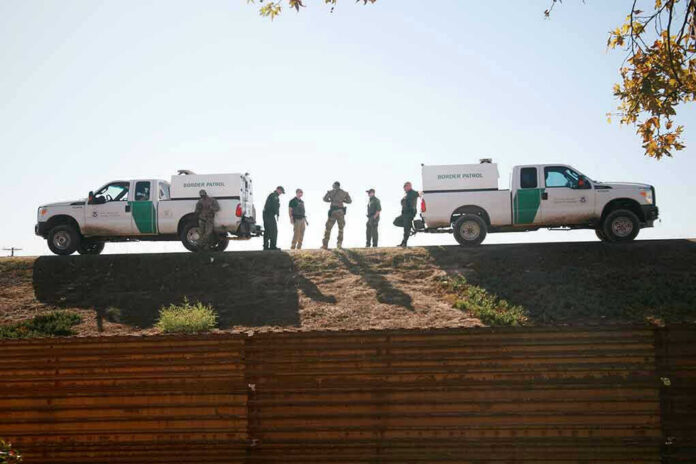
The Department of Homeland Security is deploying hundreds of AI-powered surveillance towers that operate autonomously, make their own targeting decisions, and now threaten to extend their electronic gaze far beyond the border itself.
Story Snapshot
- DHS plans 542 new AI-enabled surveillance towers and modernization of 348 legacy systems by May 2030 under a $100 million contract
- New mobile surveillance systems equipped with war drone AI technology can detect motion miles away and pinpoint locations within 250 feet autonomously
- Congress allocated $160 billion for immigration enforcement, representing a 65% funding increase for DHS operations
- Border surveillance technology is expanding into interior U.S. operations, with ICE using facial recognition tools to identify American citizens
- Border crossings have dropped to 50-year lows, though policy experts question how much surveillance infrastructure actually contributed
From Physical Walls to Digital Watchers
The transformation happening along America’s borders represents far more than steel bollards and barbed wire. Since 2019, defense contractor Anduril has quietly deployed hundreds of autonomous surveillance towers for Customs and Border Protection, creating a network of tireless digital sentries. These towers don’t sleep, don’t take breaks, and increasingly make their own decisions about what constitutes a threat. The shift from manpower to machine power marks a fundamental change in how America secures its perimeter, one that raises questions about effectiveness, civil liberties, and whether technology can solve problems that human judgment cannot.
The Smart Wall Nobody Sees
The modern border surveillance apparatus bears little resemblance to public imagination. Massive blimp-like aerostats hover thousands of feet above the desert, while unattended ground sensors detect footsteps and license plate scanners disguise themselves as traffic cones. This layered detection system represents the “smart wall” concept, a technological alternative to continuous physical barriers. The approach acknowledges geographic reality: building traditional walls across every mile of border proves prohibitively expensive and environmentally destructive. Technology promises comprehensive coverage at lower cost, though the price tag still runs into billions.
Autonomous Systems Make Their Own Calls
The newest surveillance platform, the Modular Mobile Surveillance System, operates in two modes: attended and unattended. In unattended mode, these AI-powered towers mounted on 4×4 vehicles function entirely autonomously, using computer vision technology originally developed for military drones. The system distinguishes between people, animals, and vehicles by analyzing thousands of image frames per second. It detects motion several miles away and calculates target positions within 250 feet accuracy. All captured data—video, maps, sensor information—gets retained for at least 15 days and locked against deletion under any circumstances. The classification of this data as Controlled Unclassified Information raises the stakes considerably.
Defense Contractors Cash In
General Dynamics Information Technology, Advanced Technology Systems Co., and Elbit Systems of America secured positions on a $1.8 billion contract for tower modernization in 2024. The financial opportunity extends through multiple purchase agreements lasting up to 10 years. Anduril’s early mover advantage since 2019 positioned the company favorably as DHS scales deployment. The current recompetition of a $100 million contract vehicle will award firm-fixed-price delivery orders for 542 new integrated surveillance towers plus recapitalization of 348 legacy systems. Work continues across multiple continental sites until May 2030. This represents significant revenue stability for defense contractors during uncertain economic times.
Mission Creep Beyond the Border
Mobile Fortify, an AI facial recognition tool initially developed for CBP, has migrated to Immigration and Customs Enforcement operations far from any border. Reports indicate ICE agents now use the technology to identify U.S. citizens during interior enforcement actions, applications the system was never designed for. The Electronic Frontier Foundation’s Beryl Lipton warns that border enforcement doesn’t stop at the line on the map or the moment of crossing. Civil liberties advocates challenge DHS’s classification of detection-only systems as non-rights-impacting, noting that autonomous towers capture high-resolution images the government could theoretically analyze later. This expansion from border security to interior surveillance represents the slippery slope critics long predicted.
Questioning the Numbers Game
DHS Secretary Kristi Noem touts border crossings at 50-year lows as validation of enforcement expansion. Policy analyst Kathleen Bush-Joseph from the Migration Policy Institute offers a more nuanced assessment. She acknowledges infrastructure can strategically funnel crossings toward locations where agents are positioned, but emphasizes that dominant drivers for reduced crossings include increased enforcement by Mexican authorities and the Trump administration’s deterrence campaign. The marginal impact specifically attributable to surveillance infrastructure remains unclear. No quantified data demonstrates how many interdictions resulted directly from AI tower detection versus other enforcement methods. This matters when justifying billions in technology spending.
Environmental and Cultural Costs
Environmental organizations and Native American tribes warn about impacts from bollard construction on endangered wildcats, bears, and other wildlife, along with disrupted water flows during river-swelling rains. Big Bend’s darkest skies in the country face threat from planned stadium-style floodlights. These concerns extend beyond aesthetics to fundamental questions about balancing security priorities against preservation of irreplaceable natural and cultural resources. Federal agencies have used waiver processes to bypass environmental reviews, accelerating deployment but eliminating opportunities for affected communities to meaningfully participate in decisions that alter their landscapes permanently. The long-term environmental debt accumulates silently while political attention focuses on crossing statistics.
Technology Outpacing Oversight
The sophistication of AI-powered surveillance has leaped ahead of corresponding legal frameworks and oversight mechanisms. Facial recognition technology gets deployed for identity verification tasks it wasn’t designed for, raising accuracy and reliability concerns that remain unquantified in public documentation. The Electronic Frontier Foundation challenges the fundamental premise that autonomous systems capturing detailed imagery of people don’t impact rights simply because immediate human review is absent. The data exists, permanently retained and available for future analysis under rules that may change. Americans living near borders—and increasingly in interior locations—face pervasive surveillance without explicit consent or meaningful recourse. The $160 billion allocated through the “One Big Beautiful Bill” ensures this expansion continues regardless of these unresolved questions.
Sources:
DHS CBP Integrated Surveillance Tower Contract – GovConWire
DHS Seeks AI-Powered Mobile Surveillance Trucks for Border – TechBuzz.ai
AI Texas ICE MN Tech – The Marshall Project