President Trump just confirmed the U.S. military is constructing a classified “massive complex” beneath the White House, disguised under what he calls a ballroom “shed,” and you won’t believe how he’s paying for it.
Story Highlights
- Trump revealed on Air Force One that the military is building a top-secret underground complex beneath the new White House State Ballroom, describing the ballroom as essentially a cover structure.
- The 400 million dollar project is funded entirely by private donors and Trump personally, with no taxpayer money involved, according to the President.
- The ballroom features bulletproof glass and drone-proof protections, with construction running ahead of schedule and under budget since demolition began in October 2025.
- A federal judge approved the project in February 2026 after the Justice Department cited national security concerns, despite questions about presidential authority.
- The classified facility replaces the old Presidential Emergency Operations Center, with the military handling construction independently from the publicly disclosed ballroom costs.
The Ballroom That Isn’t Really About Dancing
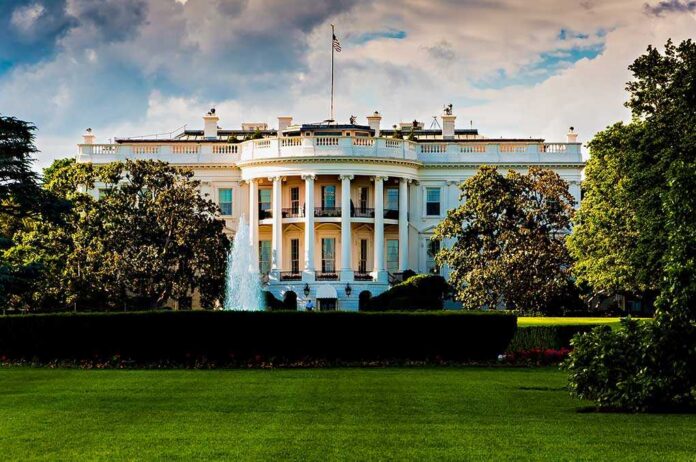
President Trump dropped a national security bombshell aboard Air Force One on March 29, 2026. The new White House State Ballroom, designed to host 999 guests at glittering state dinners, serves a far more serious purpose. Trump stated plainly that the military is constructing what he termed a “massive complex” beneath the ballroom structure. The ballroom essentially becomes a shed for what lies below, a facility so classified that White House officials refuse to discuss costs or specifications. The revelation transforms understanding of a project initially pitched as expanding event space into something far more strategic.
From Blueprint to Bunker in Eight Months
The timeline reveals breathtaking speed for a federal construction project of this magnitude. Architect James McCrery II received his commission in July 2025. By October, bulldozers had demolished the historic 1942 East Wing and dismantled the Presidential Emergency Operations Center that Vice President Cheney famously used after September 11. Clark Construction won a contract initially valued at 200 million dollars but revised upward as scope expanded. By December, construction photos showed significant progress. The U.S. Commission of Fine Arts approved designs unanimously in February 2026, just weeks before Judge Richard Leon ruled the project could proceed despite lingering authority questions.
The Money Trail Nobody Can Follow
Trump emphasized repeatedly that taxpayers are contributing “not one dime” to this endeavor. Private donors and Trump personally are funding the entire 400 million dollar price tag, according to the President. The White House released a donor list in October 2025 after raising 350 million dollars, but individual contribution amounts remain undisclosed. This funding strategy bypasses congressional appropriations and the scrutiny that accompanies them. Critics question the opacity, particularly regarding who gains influence through such massive donations. Yet supporters counter that private funding demonstrates fiscal responsibility and insulates the project from political gridlock that often paralyzes government construction.
Security Theater or Strategic Necessity
The ballroom features bulletproof glass throughout and drone-proof protections, reflecting modern threat assessments. Trump framed these measures as responses to contemporary dangers facing presidential security. The underground military complex remains shrouded in classification, with Joshua Fisher, the White House director of management and administration, confirming only that the military controls the subterranean construction independently. The facility presumably offers protection far exceeding the old Presidential Emergency Operations Center’s capabilities. Whether this represents prudent preparation or excessive fortification depends largely on one’s assessment of current threats. What seems clear is that military planners convinced Trump and his donors that substantial investment in hidden infrastructure serves national security interests worth 400 million dollars and tight secrecy.
Questions That Won’t Stay Buried
Judge Leon expressed concerns about presidential authority for such sweeping changes to the White House complex before ultimately ruling in favor of continuation. The Justice Department invoked national security to overcome these objections, a tactic that effectively ended judicial inquiry. Cost escalations from 200 million to 400 million dollars raise eyebrows, even for projects of this complexity. Ballroom capacity estimates fluctuated from 650 to 999 guests as designs evolved. Design critics argue the structure clashes aesthetically with White House architecture, though the Commission of Fine Arts disagreed. The complete lack of transparency about underground construction specifics leaves Americans trusting their President and military planners without verification, a posture that sits uncomfortably with accountability principles regardless of political affiliation.
What This Means for Executive Power
This project establishes precedent for privately funded modifications to federal landmarks justified by national security classifications. Future presidents inherit not just the facility but the template for circumventing traditional oversight mechanisms. The military’s independent role in construction separates classified from unclassified elements, creating parallel projects occupying the same physical space. Donors gain proximity to power through contributions funding presidential priorities Congress never debated. The speed of approvals, the judicial deference to security claims, and the funding opacity collectively represent a new model for executive branch infrastructure projects. Whether this model serves the Republic well or concentrates excessive power depends on trust in executive judgment and military discretion, commodities in variable supply across the political spectrum.
Sources:
US military building ‘big complex’ under White House ballroom: Trump – Anadolu Agency
White House State Ballroom – Wikipedia