
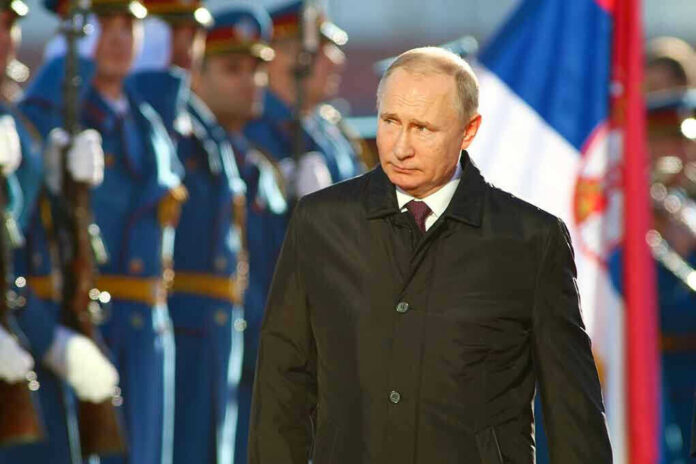
Putin’s sudden declaration that the Ukraine war is “coming to an end” contradicts his own government’s messaging just hours earlier, exposing either a dramatic shift in Russian strategy or a carefully orchestrated attempt to shape perceptions during a symbolic moment.
Quick Take
- Putin stated on May 9-10, 2026, that the Ukraine conflict “is coming to an end” following Russia’s scaled-down Victory Day parade [1][2][3]
- A U.S.-brokered three-day ceasefire began May 9, suspending all kinetic activity and including a 1,000-for-1,000 prisoner exchange [2]
- Kremlin spokesperson Dmitry Peskov had claimed just hours before that an agreement to end the conflict “is a long way off,” creating apparent internal contradiction
- Putin conditioned any meeting with Ukrainian President Volodymyr Zelenskyy on prior completion of “final agreements on a long-term peace treaty,” suggesting no such agreements currently exist [1]
- Putin provided no timeline, specific terms, or concrete steps for ending the war, making his statement aspirational rather than evidential
The Timing and the Contradiction
Russian President Vladimir Putin declared the Ukraine conflict “is coming to an end” during remarks to reporters after overseeing a military parade on Red Square commemorating Soviet victory in World War II [1][2][3]. His statement arrived within hours of Kremlin spokesperson Dmitry Peskov telling international media that an agreement to end the conflict remained “a long way off.” This stark reversal from the Kremlin’s own official position raises fundamental questions about whether Putin was signaling genuine diplomatic progress or deploying rhetoric for domestic consumption during a symbolically charged moment [2].
What the Three-Day Ceasefire Actually Accomplished
President Trump announced a three-day ceasefire running from May 9 through May 11, brokered between Russia and Ukraine, which included suspension of all kinetic activity and a mutual prisoner exchange of 1,000 combatants per side [2]. Ukrainian officials confirmed receipt of Russia’s agreement to this 1,000-for-1,000 prisoner swap within the framework of U.S.-mediated negotiations [2]. However, both sides immediately accused each other of violations during the first day of the ceasefire, with Ukraine reporting nearly 150 Russian strikes on May 9 alone [2].
Putin’s Conditional Peace Framework
Putin explicitly stated he would only meet with Zelenskyy in a third country after “final agreements on a long-term peace treaty are reached,” emphasizing such a meeting would be the “final step” rather than the beginning of negotiations [1]. This framing reveals a critical inconsistency: Putin simultaneously claims the conflict is “coming to an end” while conditioning any leadership-level diplomacy on completion of agreements he has not demonstrated exist or are imminent. The absence of publicly disclosed draft treaties, territorial frameworks, or security arrangements undermines the credibility of his “coming to an end” assertion.
The Symbolic Significance of the Scaled-Down Parade
Russia’s Victory Day parade on May 9 notably excluded heavy weapons for the first time in nearly two decades, a departure that observers interpreted as potential de-escalation signaling [1]. The security lockdown in Moscow during the parade, combined with the absence of armor and artillery displays that typically dominate the annual event, suggested Russian authorities anticipated either internal instability or external threat. Whether this restraint reflects genuine military constraints, diplomatic posturing, or strategic recalibration remains unclear from available evidence [1].
'The comment… flabbergasted us in Moscow.'
Putin hinted the Ukraine war may be ending — just hours after vowing victory.
Why this is so unusual – listen on @Reuters World News with @GuyReuters
🎧 https://t.co/RqFLzKhxB1— Tara Oakes (@tara_ro) May 10, 2026
The Credibility Gap
Putin’s statements lack specificity on any of the mechanisms necessary to end a protracted war: no timeline, no territorial framework, no security guarantees, no international verification mechanisms, and no detail on how the prisoner exchange would translate into broader peace architecture [1][2][3]. History demonstrates that leaders in active conflicts frequently issue optimistic endgame rhetoric during symbolic moments or tactical pauses to shape domestic narratives, test adversary resolve, or buy time for military repositioning. Putin’s May 9 declaration fits this well-documented pattern rather than representing concrete diplomatic movement [3].
Sources:
[1] ‘Conflict is coming to an end’: Putin makes major Ukraine war …
[2] Putin says Ukraine war is likely ‘coming to an end’ amid three-day …
[3] BREAKING: Putin Says Ukraine Conflict Is Coming to an End | AC1Z