A new community study says New York City’s congestion toll saved Midtown from traffic but shifted dirtier air onto South Bronx families already living with sky‑high asthma.
Story Snapshot
- Local monitors recorded higher fine-particulate pollution in the South Bronx after the toll launched [1][2].
- Researchers found average increases across most sites, with several hotspots near highway approaches [1][2].
- Transit officials deny a direct link and cite traffic declines plus promised mitigation money [3][4].
- The dispute mirrors global patterns where priced zones improve while edges face early pollution trade‑offs [6].
What the South Bronx monitors recorded after the toll began
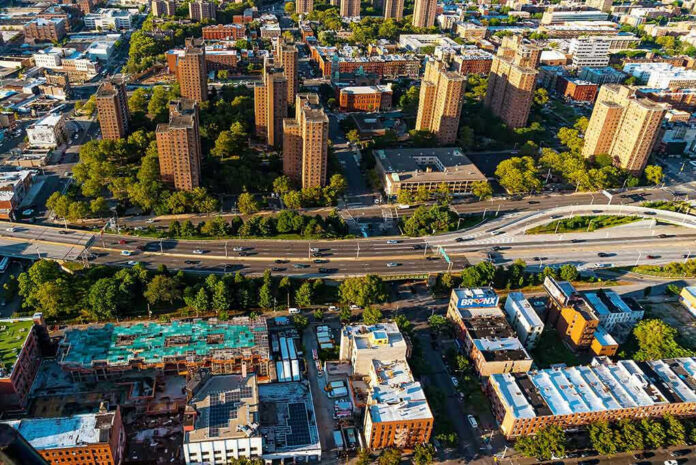
Community advocates partnered with Columbia University researchers to place nineteen monitors across the South Bronx and track fine-particulate levels through the first year of New York City’s congestion pricing program. Their analysis reported an overall uptick in average concentrations, with thirteen of nineteen sites registering increases after implementation. Local coverage summarized the findings and highlighted elevated hotspots near highway funnels serving drivers avoiding the priced zone, underscoring added risks in a neighborhood with high asthma burdens [1][2][6].
Reporters spoke with residents and advocates who described heavier truck volumes and dirtier air along corridors feeding bridges into Manhattan. Video segments showed monitors placed near ramps and distribution hubs in Mott Haven and Port Morris that registered the sharpest increases. While the community report is not peer‑reviewed, its site-level granularity, broad neighborhood coverage, and year-over-year comparison framework give policymakers concrete block-by-block signals to evaluate and verify with city instrumentation and health surveillance data [1][3][5][6].
How state transit officials push back on causation
New York’s transit authority responded that congestion pricing did not worsen South Bronx air, pointing to measured traffic declines on the Cross Bronx Expressway and the Major Deegan Expressway last spring, including a reported drop exceeding ten thousand vehicles per day. Officials also emphasized the study’s preliminary, unpublished status and referenced roughly seventy million dollars in targeted environmental mitigation projects intended to reduce neighborhood exposure near highways and logistics routes serving the central business district [3][4].
The authority’s traffic figures, if sustained, would challenge the simple rerouting narrative by weakening the mechanism that more vehicles detoured through South Bronx to avoid the toll. However, residents argue that even with fewer total vehicles, specific ramps or last‑mile truck routes can concentrate emissions on particular blocks, compounding long‑standing inequities. This is why the disagreement turns on block‑level patterns, not just boroughwide counts, and why independent validation of local peaks or dips matters for credible policymaking [3][4][6].
Why this fight echoes global congestion-pricing trade‑offs
Transportation researchers have documented a recurring pattern: priced cores often see immediate air-quality gains, while adjacent working-class neighborhoods shoulder early-stage trade‑offs from rerouting and logistics shifts. A 2026 report from South Bronx Unite framed local findings within that experience, describing modest average increases in fine particulates similar to those observed around other cities’ priced zones during their first years. That context does not settle causation, but it explains why residents demand mitigation before harms become entrenched [6].
Does @GovKathyHochul care?
Where is Councilman Justiin Sanchez? @CMPiSanchez
Where is Cong. Richie Torres? @BXMMACongestion pricing takes a toll on South Bronx air quality, report finds – Gothamist https://t.co/wNRfvcQxhb
— NYCwoes (@NycLivingin) May 9, 2026
For conservatives, the lesson is straightforward: big-ticket schemes sold by urban planners often produce unintended consequences that fall hardest on families far from elite decision rooms. Accountability starts with transparent publication of raw monitoring data, side‑by‑side with official traffic and emissions measurements, and swift course corrections when promised benefits bypass blue‑collar neighborhoods. Practical steps—truck route enforcement, targeted filtration at schools, off‑peak delivery incentives, and tangible mitigation spending—beat ideological experiments that gamble with children’s lungs [1][3][4][6].
Sources:
[1] South Bronx air quality worsens during first year of congestion pricing
[2] South Bronx Unite study finds rising pollution from congestion tolls …
[4] South Bronx environmentalists say congestion pricing is worsening …
[6] [PDF] Congestion Pricing Air Quality (5/5/26) – South Bronx Unite