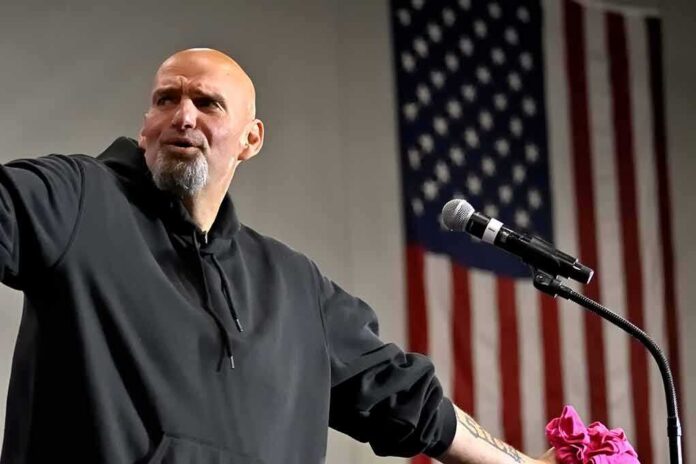
A sitting U.S. senator turned a hallway question into a public test of media funding and bias, on camera.
Story Snapshot
- Senator John Fetterman accused Drop Site News of siding with enemies of Israel during a recorded exchange.
- Fetterman pressed the outlet’s funding, asking who pays the bills and why.
- The reporter said readers fund Drop Site through 46,000 individual donors, offering no documents.
- The clash highlights how charges of bias and hidden money shape debate over Israel coverage.
What Happened In The Capitol Hallway
Senator John Fetterman of Pennsylvania confronted a reporter who identified himself as from Drop Site News. Fetterman asked why the outlet “loves Hamas and Iran and Hezbollah,” and called it “trash” and “anti-Israel.” He then pressed on money, asking who funds the site and whether the reporter is paid by people tied to those groups. The reporter said the outlet is reader funded and cited 46,000 individual donors, but did not provide records during the exchange.
The clip spread fast across social media and partisan outlets. Supporters cheered Fetterman for defending Israel. Critics warned that a senator attacking a reporter’s motives can chill press freedom. The public was left with two claims and little documentation: a harsh accusation about bias and a counter that the outlet runs on small donors. The video drove the narrative, not a paper trail, which is common in high-conflict political media.
What We Know And What We Do Not
The on-record facts are narrow. Fetterman made specific charges about sympathy for enemies of Israel and pushed on funding. The reporter replied with a donor count and said readers pay the bills. No tax filings, audited statements, or donor ledgers were presented in the available material. That means the core fight over money is still an open question in the public record provided. The accusation of being “anti-Israel” remains an assertion, not a documented content analysis.
Fetterman’s remarks also track with his broader stance on Israel policy. He has drawn a red line against any shift he views as anti-Israel, including warning he would leave Democrats if the party adopted that position. That context helps explain why he reacted so strongly to a reporter he links with that view. But it does not itself prove anything about Drop Site’s funding or editorial standards, which would require separate evidence and review.
Why This Flashpoint Resonates Beyond One Clip
This clash speaks to a deeper frustration felt across the spectrum. Many Americans believe powerful figures shape the story while facts arrive later, if at all. Viral moments reward heat over proof. When records are private or hard to access, suspicion grows. People on the right see media bias and foreign influence. People on the left see politicians smearing critical coverage. Both see elites playing information games while accountability for money and truth lags behind the headlines.
Fetterman is almost the sole sane bright spot in the entire Democrat Party.
Democratic Senator John Fetterman “puts the smackdown” on a reporter from the anti-Israel, pro-Hamas news site Dropsite:
"I love it when Hamas leaders are eliminated." pic.twitter.com/gaUEBg3QH3
— ((Hurkle Durkling)) 🇺🇸 🤟 🇮🇱 (@durklinghurkle) July 30, 2026
Clear steps could cool the temperature and serve the public. First, independent verification of Drop Site’s funding claims through filings, audits, and donor disclosures would test the 46,000 figure. Second, a neutral review of the outlet’s Israel coverage could show whether it is consistently anti-Israel or mainly critical of government policy. Third, releasing full, unedited video of the exchange would confirm whether edits shaped what viewers believe happened.
Sources:
© headlineupdates.com 2026. All rights reserved.