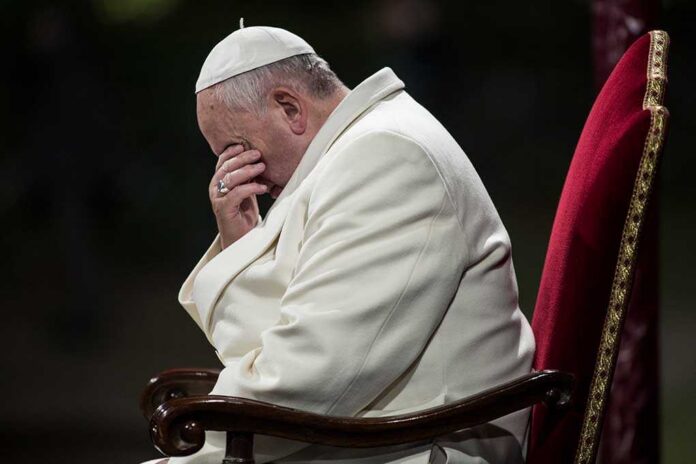
President Trump launched an unprecedented attack on Pope Leo XIV, declaring “I’m not a fan” and accusing the first American pontiff of being weak on crime and tolerant of Iran’s nuclear ambitions—a stunning clash between the White House and the Vatican that exposes the deep divide over America’s role in global conflicts.
Story Snapshot
- Trump publicly slammed Pope Leo XIV as “very liberal” and weak on crime after the pontiff criticized U.S. military actions in Iran and Venezuela
- The rebuke followed Pope Leo’s statement that a “delusion of omnipotence” fuels the U.S.-Israel war in Iran, delivered as ceasefire negotiations began in Pakistan
- Trump suggested the American-born pope was elected specifically to counter his presidency, claiming papal interference in U.S. foreign policy decisions
- The extraordinary public feud marks a rare breakdown in U.S.-Vatican relations, with analysts calling Trump’s response “stinging” and “exceedingly rare”
Trump’s Unfiltered Criticism of the Pope
President Trump delivered a blistering critique of Pope Leo XIV on Sunday, both on social media and to reporters on the tarmac after returning from Florida to Washington. Trump stated bluntly, “We don’t like a pope that’s going to say that it’s okay to have a nuclear weapon. He’s a very liberal person and he’s a man that doesn’t believe in stopping crime.” The president’s remarks came after Pope Leo XIV presided over an evening prayer service at St. Peter’s Basilica on Saturday, where he suggested that a “delusion of omnipotence” drives the U.S.-Israel military campaign in Iran.
The president’s social media post went further, accusing Pope Leo of being “WEAK on Crime” and catering to the “Radical Left.” Trump insisted he doesn’t want a pope who tolerates Iran acquiring nuclear weapons or who criticizes U.S. strikes against Venezuela’s drug trafficking networks. The timing of Trump’s attack is significant, occurring as U.S. negotiators engage in fragile ceasefire talks with Iran in Pakistan. Trump’s remarks underscore his frustration with what he perceives as papal interference in American foreign policy at a critical moment.
A Pope Positioned Against America First
Trump made an extraordinary claim that Pope Leo XIV’s election was strategically orchestrated to counter his presidency. “If I wasn’t in the White House, Leo wouldn’t be in the Vatican,” Trump asserted, suggesting the choice of the first American pope was politically motivated. This allegation reflects Trump’s broader suspicion of establishment institutions working against his administration’s agenda. Pope Leo XIV’s background as a U.S.-born pontiff has become a focal point, with Trump portraying him as an extension of domestic political opposition rather than a neutral spiritual leader.
The president’s evangelical base has rallied around his Iran policy, with some claiming divine support for the military action. This creates a stark contrast with the Vatican’s peace advocacy. Trump’s reference to his 2024 “landslide election” reinforces his claim to a democratic mandate that he believes supersedes papal moral authority on matters of national security. The power dynamics reveal a president who sees Pope Leo not as a spiritual counterweight but as a political adversary aligned with forces opposing conservative governance and American sovereignty.
Implications for Faith and Foreign Policy
The clash between Trump and Pope Leo XIV carries significant implications for American Catholics, who find themselves caught between political and religious leadership. The short-term impact escalates U.S.-Vatican tensions precisely when delicate Iran ceasefire negotiations require diplomatic stability. Long-term consequences could further polarize U.S. Catholics along political lines, with conservatives backing Trump’s strong stance on crime and nuclear proliferation while others heed the pope’s peace advocacy. Experts note the rarity of such direct presidential attacks on a sitting pope, calling Trump’s response “extraordinary.”
For many Americans frustrated with government failures, this conflict highlights a fundamental question: should elected leaders defer to religious authorities on matters of war and peace, or does democratic accountability supersede clerical influence? Trump’s position resonates with those who believe unelected global elites—whether in international organizations or religious institutions—undermine American sovereignty. The president’s defense of military action against Iran and Venezuela reflects his commitment to protecting American interests through strength, a principle he argues transcends papal objections rooted in what he characterizes as liberal ideology rather than practical security concerns.
Sources:
Trump attacks Pope Leo XIV over Iran criticism – America Magazine