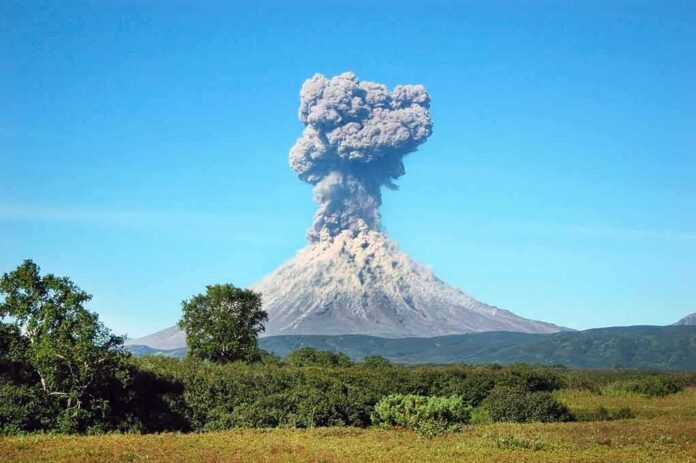
Indonesia’s Mount Semeru fired off a rapid series of eruptions in about 13 hours, pushing ash up to 900 meters and triggering fresh hazard warnings.
Story Snapshot
- Officials logged repeated eruptions from after midnight to early afternoon local time.
- Ash plumes rose as high as 900 meters above the summit during the sequence.
- Monitors reported seismic signals tied to individual blasts with noted amplitudes.
- Authorities kept exclusion zones due to risks from hot flows and mudflows.
What Officials Reported About The Eruption Run
Indonesia’s volcanology agency linked reports said Mount Semeru erupted at least 10 times between 12:09 a.m. and 1:11 p.m. local time on October 13, 2026. Newsrooms that cited the agency listed five blasts before dawn, more in the morning, and one early afternoon event. Other Indonesian outlets counted nine through late morning, a difference likely due to the cutoff time used for tallying. All accounts agree on multiple eruptions within the span.
Monitors described ash plumes that rose several hundred meters above the summit, with peaks near 900 meters during the morning activity. One report logged a 10:37 a.m. eruption with a seismic amplitude of 22 millimeters and a duration of 137 seconds. Another noted the 1:11 p.m. event with a maximum amplitude of 15 millimeters and duration of 88 seconds. These readings show that the blasts were not only seen but also recorded by instruments.
Why Hazard Zones Remained In Place
The Center for Volcanology and Geological Hazard Mitigation kept Mount Semeru at Level Three on its four-tier scale and urged people to stay out of known danger areas. Officials warned against any activity within 13 kilometers along the Besuk Kobokan River channel, where deadly hot flows have traveled in past crises. Separate guidance kept a five-kilometer radius around the crater due to the risk from falling hot rocks and sudden blasts.
These limits reflect how this volcano behaves in cycles. The Smithsonian Global Volcanism Program notes Semeru has shown near-continuous activity for decades, but with some periods turning deadly when domes collapse or flows surge down valleys. In December 2021, a major episode sent ash high into the sky and unleashed hot flows and mudflows that harmed communities. That record explains why officials move fast when ash and seismic signals pick up.
What We Know—and Do Not—About Local Impacts
Reports focused on the eruptions, ash heights, and hazard posture. They did not list injuries, evacuations, or damage linked to the October 13 sequence itself. That silence does not mean risk was low; it means the available updates emphasized monitoring and warnings. Weather can quickly turn ash into mudflows, and sudden collapses can send hot clouds down valleys, so keeping clear of channels is key when the mountain is restless.
🌋 Volcanic Ash Advisory: Semeru
Mount Semeru, Indonesia: eruption reported at 14:46 UTC on 8 October 2026. Ash reached 15,000 feet and was moving east at 5 knots. Advisory issued at 18:20 UTC; ground reports indicate ongoing eruptions.More info: https://t.co/oFT17RBMZe
— Early Warning (@VolcanoEWS) October 8, 2026
Conflicting eruption counts across outlets can look odd, but timing explains much of it. Some outlets tallied nine events through 11:00 a.m., while others included the 1:11 p.m. blast to reach 10. For people who live and work near the volcano, the core message is the same: repeated blasts, measurable ash, and active seismic signals point to real hazards. Staying outside exclusion zones reduces the chance that a routine workday turns into a rescue.
Sources:
insiderpaper.com, megapolitan.antaranews.com, malaymail.com, databoks.katadata.co.id, link.springer.com
© headlineupdates.com 2026. All rights reserved.