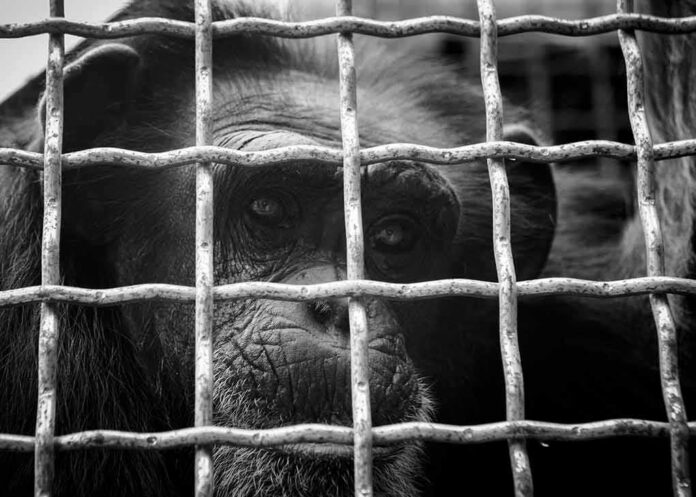
A decades-old chimpanzee illness at a U.S. Army lab is now fueling a fight over where a common child virus came from—and what the government is not telling us.
Story Snapshot
- Scientists first isolated a chimpanzee cold virus in 1955 at Walter Reed; it matched a virus later found in sick infants.
- Reports describe a lab worker who fell ill after handling infected chimps, showing human exposure inside the facility.
- Evidence shows human infection long before 1955, undercutting claims of a lab origin or vaccine spread.
- A leading historical review says the chimp and infant cases reflected local circulation, not creation or release by a lab.
What the Walter Reed chimpanzee outbreak actually showed
In October 1955, chimpanzees at a Walter Reed Army research annex developed cold-like symptoms. Lab teams isolated a virus they called “chimpanzee coryza agent.” They showed it could spread among chimpanzees. Within a year, scientists at Johns Hopkins University linked a similar virus to infants with respiratory illness. Later work recognized these as the same or closely related to what we now call respiratory syncytial virus. This ties discovery to a lab event, not proven origin.
Reports from that period also describe a laboratory worker who became sick after contact with infected chimpanzees. Testing suggested the worker and the animals had the same virus. That is a documented exposure inside a research setting. It raises fair questions about safety and oversight. But a single workplace illness does not prove wider spread from the lab into the community. It also does not show a vaccine pathway to the public.
Why discovery is not the same as origin
Historical evidence points to broad human exposure years before the chimpanzee outbreak. A 1957 Johns Hopkins report found that 80 percent of tested Baltimore children had antibodies by age four. A 2007 study detected respiratory syncytial virus proteins in tissue from a child who died in 1931. These findings cut against the claim that the virus started at Walter Reed or moved to the public through vaccines. They place circulation in humans well before 1955.
A major 2025 review in a microbiology journal concluded the chimpanzee and infant findings likely reflected regional circulation near Walter Reed and Johns Hopkins. The review noted positive tests among people close to the scene, which fits person-to-person spread already happening. The authors described a plausible route where human caretakers infected the chimpanzees, not the other way around. That line keeps the facts while avoiding leaps about lab creation or release.
The vaccine-contamination claim and what records do—and do not—show
The strongest versions of the claim suggest early vaccines carried the virus into the public. That would need specific proof: a contaminated batch, chain-of-custody records, and matching genomes. The available record does not show those links. Reporting also notes that early polio vaccines used monkey, not chimpanzee, kidney cells, which weakens a direct tie between the chimp event and vaccine production at the time.
@SecKennedy is this true, or did @NIHDirector_Jay do what he always does….feed the torture@SecRollins
A new @WhiteCoatWaste (WCW) investigation exposes $779,689 in new NIH funding under Secretary Robert F. Kennedy Jr. for an animal experimentation collaboration with a…
— LiberteaIL (@Liberty17673683) October 11, 2026
Genetic studies also complicate the story. A 2023 analysis estimated the two main respiratory syncytial virus families appeared around 1953 and 1956, which overlaps the Walter Reed period but does not pin the start on a lab or a vaccine. Timelines like this show when lineages split. They do not, by themselves, show who infected whom, or how the virus reached the public. They are one piece of a larger record that points to human circulation before 1955.
Why this debate hits a nerve across the political divide
Americans on the right and left see a pattern: officials blur lines, critics overstate, and the truth gets lost. Here, discovery in a lab became, in the public mind, the origin story. A real workplace exposure became a claim of mass release. Agencies answered with short quotes that skipped key details. That cycle feeds distrust. Clear records, open archives, and precise language would help people judge the facts without spin or fear.
Bottom line: what we know, what we do not
The historical record supports three firm points. First, scientists first isolated the virus in chimpanzees at Walter Reed, and later linked it to sick infants. Second, a lab worker likely caught the same virus inside the facility. Third, strong evidence shows humans had the virus long before 1955, which argues against a lab origin or vaccine spread to the public. Claims beyond these facts need documents, data, and genomes that have not been shown.
Sources:
theatlantic.com, pmc.ncbi.nlm.nih.gov, childrenshealthdefense.org
© headlineupdates.com 2026. All rights reserved.