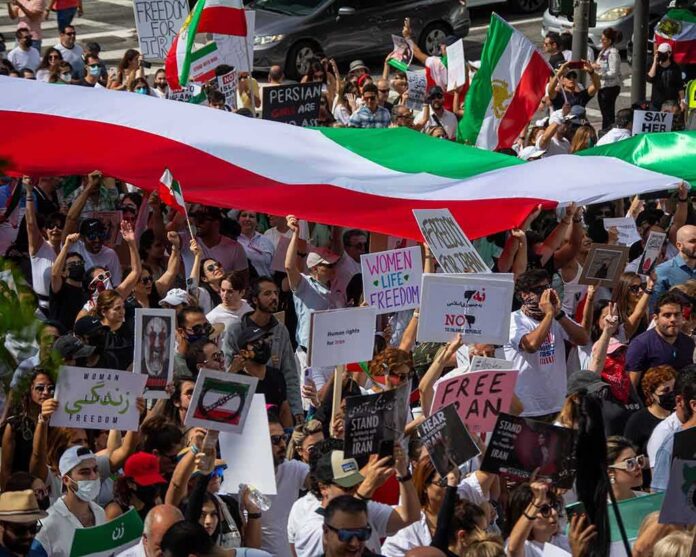
As Iranian dissidents waved the banned Lion-and-Sun flag outside a World Cup stadium in Los Angeles, global soccer bosses sided with Tehran’s censors and tried to shut them down.
Story Snapshot
- Iranian dissidents turned Iran’s World Cup opener in Los Angeles into a major protest against the regime in Tehran.
- Protesters flew the pre-1979 Lion-and-Sun flag, a historic symbol now widely used to oppose Iran’s Islamic dictatorship.
- FIFA kept its ban on the Lion-and-Sun flag inside stadiums, even as Iranian Americans sued and took their case to U.S. courts.
- The clash shows how global sports bodies police “politics” while tolerating some causes and silencing others.
Iran’s World Cup Match Becomes a Street Referendum on the Regime
Outside the Los Angeles World Cup venue, hundreds of Iranian Americans gathered as Iran faced New Zealand in its opening match, and the scene looked less like a pre-game party and more like a referendum on the rulers in Tehran.[1] Many demonstrators wore and carried red, white, and green flags marked with the golden Lion and Sun, and they chanted against the Islamic Republic’s deadly crackdown on protesters earlier in the year.[1] For these dissidents, the match was not just about soccer.
Protesters called the team on the field “the Islamic Republic’s contingent,” arguing that the squad, uniforms, and anthem all serve the same propaganda machine that jails students and shoots women who refuse compulsory veils. They used the World Cup spotlight to name political prisoners and victims of the regime’s January violence back home.[1] For many in this crowd, cheering the team would feel like cheering the same security state they fled, so they chose to stand outside and make their voices heard.
Why the Lion-and-Sun Flag Cuts to the Heart of the Fight
The flag battle at the gates was about far more than fabric; it was about who gets to define Iran. Before the 1979 Islamic Revolution, the Lion-and-Sun tricolor was the official national flag, but the new rulers banned it and replaced the emblem with their own Islamic symbol. Since then, Iranian opposition groups and diaspora communities have embraced the Lion and Sun as a sign of resistance to the current government and a broader symbol of secular freedom.[1]
At marches from Tehran to Toronto, the prerevolution flag now appears alongside slogans for women’s rights and free elections, and protesters see it as the “real” flag of Iran, not the banner of the clerics. Images from recent unrest show demonstrators tearing down the Islamic Republic’s flag and raising the Lion and Sun instead, an act that directly rejects the theocracy’s claim to speak for the nation. That is why Tehran treats the emblem as a threat and why dissidents insist on carrying it to global events where cameras are rolling.
FIFA’s “No Politics” Rule Hits One Side Harder Than the Other
Global soccer officials responded to this fight by backing the regime’s red lines. The international body that runs the World Cup kept its ban on the Lion-and-Sun flag inside stadiums, labeling it a political symbol and warning security to stop it at the gates.[2][5] Just hours before kickoff in Los Angeles, a judge upheld that policy, rejecting an Iranian American group’s lawsuit that argued the rule trampled free expression at a public event.[1]
Reporters at the scene described security guards blocking fans who tried to bring the prerevolution banner into the stands, even when those fans said they only wanted to show pride in their heritage while condemning tyranny.[2] Yet critics note that other flags tied to modern political conflicts, including the Palestinian flag, often pass without the same level of scrutiny, even though they also signal support or opposition to governments.[3] That uneven enforcement fuels the belief that so-called neutral rules tend to favor regimes willing to punish dissent, not the people risking everything to oppose them.
The Deeper Pattern: When Sports, Speech, and Freedom Collide
What happened in Los Angeles fits a long pattern where mega-sporting events become battlegrounds for free speech. From Olympic podium protests to National Football League anthem kneeling, athletes and fans have used games to speak about war, civil rights, and state abuse, forcing leagues to choose between real neutrality and selective silence. The Iranian case adds another chapter, with a historic national flag turned into a dissident badge that stadium officials try to erase from view.
Iranian-Americans protest in Los Angeles as Iran draw 2–2 with New Zealand amid World Cup political tensions. https://t.co/WLLOJ5iJrr pic.twitter.com/NW8F16xyF9
— ARISE NEWS (@ARISEtv) June 16, 2026
For American readers, this fight over a flag at a soccer match should feel familiar. It raises the same core question we face at home: who decides which messages are allowed in public space, and on what terms. Iranian dissidents in Los Angeles answered that question by standing outside the gates with their Lion-and-Sun banners raised high, sending a message not only to Tehran but also to every global body tempted to trade liberty for “order” when the cameras turn on.
Sources:
[1] Web – Iranian Dissidents Fly Persian Flag, Protest Massacre at World Cup …
[2] Web – Why Are Iranian Protesters Using the Prerevolution Lion and Sun …
[3] Web – At Iran’s World Cup opener, a banned flag became a flashpoint at …
[5] Web – At least 200 Iranians gathered outside a World Cup stadium in Los …
© headlineupdates.com 2026. All rights reserved.