
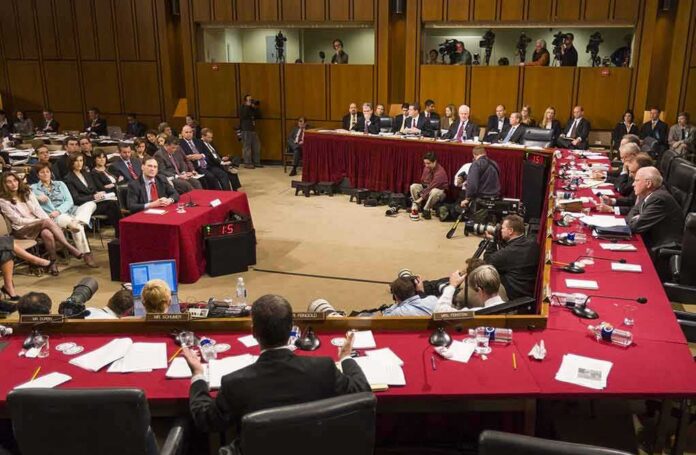
As senators grilled Dr. Anthony Fauci over COVID-19, his decision to both rely on a presidential pardon and invoke the Fifth Amendment exposed how legal shields for powerful insiders deepen public doubts about whether the system plays fair for anyone else.
Story Snapshot
- Dr. Fauci invoked his Fifth Amendment right more than 100 times in a GOP-led Senate hearing.
- Senator Rand Paul argued Fauci’s pardon means he should fully testify, calling his Fifth Amendment claim “unsupported.”
- Legal experts say a pardon and the Fifth Amendment can both apply, because a pardon does not erase all legal risk.
- The clash highlights how top officials often have tools to avoid full accountability that regular Americans do not.
What Happened At The Fauci Hearing
On Wednesday, Dr. Anthony Fauci appeared before the Senate Committee on Homeland Security and Governmental Affairs, now led by Republicans and chaired by Senator Rand Paul. The hearing focused on the origins of COVID-19 and whether Fauci misled Congress or the public during the pandemic response. In his opening statement, Fauci said that, “under the advice of my attorneys,” he would invoke his right under the Fifth Amendment and decline to answer questions. He then refused to respond to essentially every question asked.
During the hours-long hearing, Fauci repeated a single line again and again: “On the advice of counsel, I respectfully decline to answer based upon my rights under the Fifth Amendment of the Constitution.” Reports say he used that answer more than 100 times, even for simple questions meant to mock his silence, like the color of his tie. Fauci said it “pains” him to do this but claimed Senator Paul has an “unhinged obsession” with prosecuting him and might twist his words into a criminal case.
Why Senator Rand Paul Says The Fifth Amendment Should Not Apply
Senator Rand Paul told Fauci that the committee had already scheduled a vote on whether to hold him in contempt of Congress for refusing to answer subpoenaed questions. Paul argued that Fauci’s reliance on the Fifth Amendment was “unsupported” because of a “blanket pardon” that Fauci reportedly received from President Trump for past conduct related to the pandemic response. Paul said a pardon removes the risk of federal charges for that prior conduct, so Fauci should not need protection from self-incrimination when asked about it.
Paul also claimed that the pardon is not a license to commit future crimes, such as lying under oath now, and insisted that Congress has a legal right to demand straight answers. From Paul’s view, if Fauci is truly innocent and already pardoned for whatever Republicans think he did, then refusing to talk looks like a deliberate effort to hide the truth rather than a reasonable legal strategy. This framing fits the broader anger many Americans feel when they see powerful officials appear to dodge tough questions without real consequences.
How The Fifth Amendment And Pardons Really Work
The Fifth Amendment says no person can be forced in any criminal case to be a witness against himself. Legal analysts quoted in coverage of the hearing stress that invoking the Fifth Amendment is a constitutional right, not an automatic sign of guilt or corruption. A witness may use it whenever truthful answers could reasonably help build a criminal case against them, including a charge like perjury if their statements are later judged misleading or incomplete. This protection applies even when no indictment has been filed yet.
A presidential pardon can remove the risk of federal charges for specific past acts, but it does not erase every possible legal threat. It does not protect someone from state-level prosecution, from charges based on conduct outside the pardon’s scope, or from new crimes such as lying under oath today. That means, as a matter of law, a person can both hold a pardon and still have reasons to fear self-incrimination on certain questions. In those situations, lawyers may still advise clients to invoke the Fifth Amendment to avoid giving prosecutors or political foes new ammunition.
Why This Feels Like “Rules For Elites” To Many Americans
Many citizens watching this clash see more than a technical legal debate. They see a famous government scientist, backed by lawyers and a presidential pardon, refusing to answer basic questions about decisions that changed everyday life for millions of people. At the same time, Senator Paul and other Republicans are using the tools of Congress to press their own narrative, turning the hearing into sharp political theater rather than a clear search for truth. For people on both the right and the left, that is a familiar and frustrating pattern.
Yesterday, Dr. Anthony Fauci appeared before the Senate Homeland Security Committee and invoked the Fifth Amendment 111 times, declining to answer questions about the origins of COVID-19, gain-of-function research funding, and the federal response to the pandemic.
Senators… pic.twitter.com/jDICFoAvgj
— Americans for Health Freedom (@AmerHlthFreedom) July 30, 2026
Conservatives angry about lockdowns, mandates, and shifting COVID messaging see Fauci’s silence as proof that insiders never have to fully answer for mistakes that hurt working families. Liberals who fear abuse of power and politicized attacks on science see a different problem: a Senate majority using its control to stage a show trial that may not fix anything in the health system. Both sides, though, can look at this hearing and feel the same deeper worry — that when it comes to the people at the top, the system is built to protect them first and explain things to the public later, if at all.
What To Watch Next
Senator Paul says the committee will vote on a resolution to certify Fauci in contempt of Congress for refusing to answer. That step could send the matter to the Department of Justice for possible action, but history shows contempt referrals against well-connected figures are often slow-walked or dropped. Meanwhile, some state officials are reportedly seeking Fauci-related records to explore state charges, which would fall outside any federal pardon. Legal experts expect more fights over the exact language and reach of the pardon itself.
For Americans trying to make sense of this, the key point is simple. Under our Constitution, a person is allowed to say “I won’t answer” if honest testimony could be used against them. That right does not prove innocence or guilt on its own. But when a powerful figure uses both a pardon and the Fifth Amendment, it feeds a growing belief that there are two justice systems in this country — one for regular people and one for the deep state and political elites who rarely face full accountability.
Sources:
youtube.com, aljazeera.com, nypost.com, nbcnews.com, pbs.org, axios.com
© headlineupdates.com 2026. All rights reserved.