As flames race across Colorado and three federal firefighters lie dead, thousands of families are learning yet again that when disaster strikes, the system protects itself faster than it protects them.
Story Snapshot
- Three federal wildland firefighters were killed and two injured in the Snyder Fire burnover on the Colorado–Utah border.
- Nine major wildfires have burned more than 84,000 acres statewide, with containment still very low.
- The Aspen Acres and nearby Custer County fires exploded in size, forcing mandatory evacuations for several southern Colorado towns.
- Governor Jared Polis declared a disaster emergency and activated the Colorado National Guard as air quality turned unhealthy across the Front Range.
Deadly Snyder Fire Exposes Risks Faced by Frontline Crews
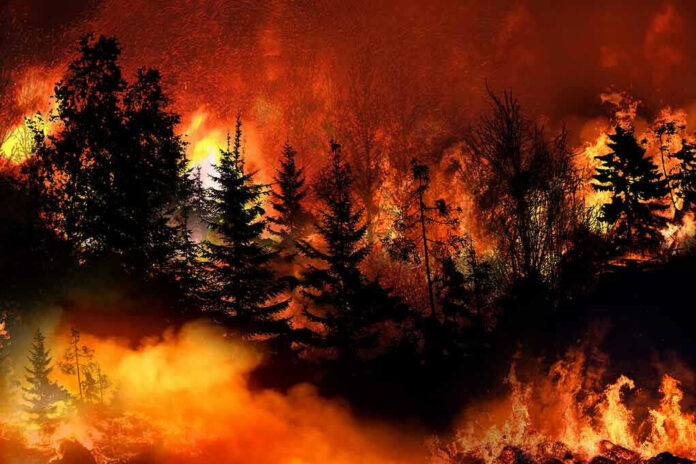
Three wildland firefighters died and two were badly hurt when the Snyder Fire burned over their position near the Colorado–Utah border. Federal officials say they were part of an interagency team working the Knowles and Gore fires when fast‑moving flames cut off escape routes. Reports describe blistering heat, dry fuel, and strong winds that turned a routine assignment into a fatal trap. The National Weather Service warned of “extreme fire behavior” in the Four Corners region, meaning fires could grow and spread much faster than crews can safely move.
Crews on the Western Slope are now fighting a merged complex that includes the Jones, Knowles, Gore, and Snyder Mesa fires. Estimates put the Snyder Fire at more than 28,000 acres with little or no containment when the fatalities occurred. Some mapping tools now show it above 30,000 acres as teams slowly cut fire lines in rough canyon country. For families of the fallen, basic questions remain: why were crews in such a risky position, and could better planning or equipment have saved them? Those answers will likely come only after federal investigations are complete.
Explosive Growth of Southern Colorado Fires and Mass Evacuations
While the Snyder Fire burned on the Western Slope, southern Colorado saw its own nightmare as the Aspen Acres area fire blew up from a few thousand acres to tens of thousands in less than a day. Local outlets report one blaze near Rye and Beulah racing past 23,000 acres with zero containment, pushed by very dry brush and strong winds. Mandatory evacuations hit towns including Beulah, Rye, San Isabel, and nearby rural neighborhoods, sending about 4,000 people from their homes with little time to pack.
At least a handful of homes are confirmed destroyed, and more than 2,000 structures sit in the fire’s path. The Custer County fire near Rye is now listed around 28,000 acres with no containment, showing how quickly one spark in the wrong conditions can threaten entire communities. For residents, this is not a partisan story; whether they voted red or blue, they had to grab kids, pets, and papers and then sit in traffic wondering if anything would be left when they came back. Many describe feeling on their own, even as press conferences promise “all available resources.”
Statewide Impact: 84,000+ Acres Burned and Unhealthy Air
Across Colorado, nine major wildfires have burned more than 84,000 acres in just days. This includes large incidents on the Western Slope and in southern counties, plus smaller but still dangerous fires scattered across the mountains. Maps from wildfire tracking tools show multiple red flag zones where heat, low humidity, and frequent wind gusts make new starts likely and slow containment on existing blazes. Air operations have been limited at times because wind makes water and retardant drops less effective and more dangerous for pilots.
Smoke from these fires is spreading far beyond the burn areas, pushing air quality index readings above 100 in parts of the Front Range and turning skies hazy over cities like Denver and Colorado Springs. Health officials warn that people with asthma, heart disease, and other lung issues should stay inside when possible and use air filters or masks outdoors. For many Coloradans, it feels like one more hit in a long run of crises: first inflation, then energy shocks, now weeks where simply breathing outside comes with a health warning.
Why These Fires Keep Getting Worse — And What It Says About the System
Researchers at Colorado State University have tracked wildfire trends over the past 30 years and found that Colorado fires are becoming more frequent, larger, and more extreme. From 1990 to today, a growing share of the total burned area comes from a small number of huge events rather than many small ones. Hotter summers, long‑term drought, and forest areas packed with dry fuel all play a part. Once a fire starts in these conditions, it can blow past older planning models and outpace ground crews in a matter of hours.
Colorado wildfires destroy more than 100 structures, force more evacuations https://t.co/lCsanuWnQA pic.twitter.com/OMqDPuKLcO
— Canon City DR (@ccdr) July 1, 2026
Official guides now tell residents that wildfires are not a question of “if” but “when.” The Colorado State Forest Service urges families to make clear evacuation plans, prepare “go bags,” and know at least two ways out of their neighborhood. County emergency manuals warn people to leave right away when ordered, because delays cost lives. That advice is sound, but it also sends a deeper message: regular people must be ready to save themselves. Many on both the left and right see that as proof that the system is better at issuing warnings than fixing the long‑term problems that make these mega‑fires so common.
Shared Frustration: Government Response Versus Everyday Reality
Governor Jared Polis has declared disaster emergencies for several fires, activated the Colorado National Guard, and praised the bravery of federal and local crews. That is standard for any governor facing a major disaster. Yet for evacuees sleeping in gyms or church basements, and for small business owners watching their assets go up in smoke, the pattern feels familiar. Big speeches, slow relief checks, and years of fights over insurance and rebuilding rules have followed past fires as well.
Conservatives look at this and see more proof that long‑promised forest work and smarter land management never truly happened. Liberals look and see poor rural communities bearing the brunt while big energy and real estate interests carry on. Both sides see federal and state agencies quick to protect their reputations but slow to share full details on firefighter deaths, ignition sources, or missed chances to stop small fires from becoming large ones. As Colorado burns again, the shared fear is not just of flames, but of a system that treats growing disaster as the new normal and asks ordinary people to simply “be ready” for the next one.
Sources:
youtube.com, denvergazette.com, coloradosun.com, facebook.com, en.wikipedia.org, wildfirepartners.org, instagram.com, co-pub.coloradoforestatlas.org, hazards.colorado.edu, jeffco.us
© headlineupdates.com 2026. All rights reserved.