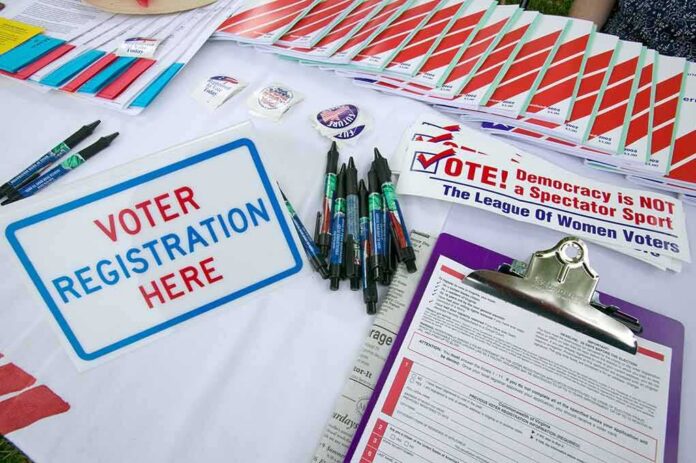
A federal case over paid voter registrations on Los Angeles’ Skid Row is now feeding a much bigger fight over whether California’s election system can be trusted.
Story Snapshot
- A Marina del Rey woman admits paying homeless people on Skid Row to register to vote, a federal felony.
- The scheme ran for years and tied voter registrations to paid petition work using cash and fake information.
- Trump’s Justice Department is using the case to press broader claims about noncitizen voting and bad voter rolls in California.
- California officials and outside experts say proven fraud cases are rare and do not show a broken system.
Federal case exposes paid voter registrations on Skid Row
Federal prosecutors say Brenda Lee Brown Armstrong, a 64‑year‑old Marina del Rey resident and longtime petition worker, spent years paying people, including homeless residents of Skid Row in downtown Los Angeles, to sign petitions and register to vote. The United States Department of Justice states she is charged with one felony count of paying another person to register to vote in a federal election, a crime that can carry up to five years in prison. In her plea agreement, Armstrong admits she offered cash between two and three dollars to induce people to sign and register. Social media and news posts echo that description and show federal officials publicly framing the conduct as part of an ongoing push against election abuses in California.
Justice Department documents say Armstrong worked as a paid “petition circulator” for about twenty years, collecting signatures to qualify statewide initiatives, referendums, and recall efforts for the ballot. Skid Row, known for its heavy concentration of homeless residents in a small area, became a regular stop for her because many people there would sign papers for a few dollars. According to the federal filing, she sometimes used fake addresses and other false information when registering people, and on January 30, 2026, she knowingly paid someone specifically to register to vote in federal elections. That payment is the act behind the felony charge and her agreement to plead guilty.
How this fits a pattern of targeted fraud, not mass breakdown
California’s own reviews of election fraud show scattered but real cases involving paid registration and signature schemes, often focused on vulnerable people like the homeless. One state literature review describes an earlier Skid Row scheme where a man offered cigarettes and money to homeless individuals in exchange for fake signatures and voter registration forms, producing hundreds of bad signatures. A separate 2006 case in Orange County charged twelve people with fraudulently completing voter registration cards for unsuspecting residents, again tied to campaign-style operations rather than ordinary voters acting alone. These examples show that small‑scale fraud exists and tends to cluster where money, petitions, and desperation meet, but they also underline that such cases are usually limited in number and scope.
Independent tallies of voter fraud convictions in California since 2016 find dozens of cases, not thousands, and many involve workers gaming petition and registration rules rather than large groups of fake voters casting ballots. A detailed explainer from a California news outlet notes that experts and the California Secretary of State say there is no sign of widespread fraud and no evidence that it happens often. Instead, they point to occasional cheating that is usually caught and prosecuted, including fake ballot drop boxes, double voting, or forged signatures. National research on voting by mail also finds no proof that mail ballots, which many Californians use, raise overall fraud levels, and stresses that people who abuse the system face serious penalties. Together, these sources suggest Armstrong’s case is serious but fits a long‑running pattern of targeted abuses inside a much larger system that mostly works.
Trump-era clash over noncitizen voting and voter rolls
While the Armstrong case is clear and uncontested, it lands in the middle of a fierce 2026 battle over whether noncitizens are voting and whether states like California have allowed their rolls to become badly tainted. The Department of Homeland Security, under President Donald Trump, has claimed that more than 250,000 potential noncitizens are registered across four states and says about 190,000 of those are in California, while threatening fines and legal action if states do not scrub their lists. California Democrats and election officials strongly reject those numbers, saying the administration has not provided supporting evidence and calling the figures wildly speculative.
A Trump‑appointed federal prosecutor in California has publicly said his office is pursuing “multiple” election fraud investigations and has pointed to Armstrong’s case as proof that voter fraud does exist in the state. He argues that paying homeless individuals to register using false information is not just a technical violation but a sign of deeper problems in how registrations are handled. At the same time, he has admitted his team is still “searching for any form of widespread conspiracies” and has not yet produced a case showing large‑scale, organized fraud. Civil rights groups note that a recent Justice Department lawsuit seeking California’s full voter registration list, including personal data, was thrown out by a federal judge, signaling limits on how far the federal government can go in demanding voter information.
Shared fears about system integrity and official accountability
People on both the right and the left see the Armstrong case through their own worries, but many share a core concern: the feeling that the rules favor insiders and that ordinary votes can be gamed. For conservatives, a federal guilty plea for paid voter registrations in Los Angeles fuels long‑standing fears that election officials in deep‑blue California have turned a blind eye to abuse and that noncitizens and fake addresses might be slipping through. For liberals, the same case raises questions about why it took federal prosecutors, not state leaders, to crack down, and whether vulnerable homeless residents are being exploited while wealthier political actors stay untouched.
🚨 The DOJ secured a federal guilty plea in a California voter fraud case — but James O'Keefe says no state official has made a single arrest or launched a prosecution.
O'Keefe Media Group's undercover journalists posed as homeless individuals on Skid Row in Los Angeles in March… pic.twitter.com/v0xcZnEvDF
— Lincoln Media Foundation (@LincolnMediaHQ) July 21, 2026
California’s “trusted information” guidance stresses that it is illegal for officials to tamper with ballots, cast votes for dead people, or interfere with voters’ privacy, and reminds residents that there are rules against observers or staff collecting private voter data. Yet the very need for these reminders shows how shaky public trust has become. Many Americans now doubt not only party leaders but also government agencies charged with protecting elections, suspecting that elites in both parties care more about power than about clean rolls and fair counts. Armstrong’s admitted scheme on Skid Row does not prove mass fraud, but it gives both sides more reason to demand tighter controls, clearer data, and real accountability from the people running the system.
Sources:
redstate.com, abc7.com, youtube.com, instagram.com, facebook.com, pbs.org, cnn.com, democracydocket.com, nbcbayarea.com, selc.senate.ca.gov, admin.cdn.sos.ca.gov, archive.amarkfoundation.org, reddit.com
© headlineupdates.com 2026. All rights reserved.